Long before his face appeared on currency, monuments, and history books, George Washington was a young Virginian trying to find his place in a rapidly changing world.
Born on February 22, 1732, in Westmoreland County, Virginia, Washington grew up in a family connected to farming and land ownership. As a young man, he developed experience as a surveyor and later became involved in Virginia’s military affairs.
But his life changed dramatically as tensions between Great Britain and the American colonies grew.
From Soldier to Revolutionary Leader
Washington served in the Virginia militia during the French and Indian War. Those experiences exposed him to military leadership and the difficult realities of warfare.
Years later, when the American Revolution began, the Continental Congress selected Washington to command the Continental Army.
The assignment was enormous.
The colonies were attempting to defeat one of the world’s most powerful military empires.
Washington faced shortages of food, clothing, weapons, money, and trained soldiers. His army endured difficult conditions, including the harsh winter at Valley Forge.
The war was not won through one battle.
It required years of fighting, strategic decisions, alliances, persistence, and extraordinary sacrifice.
In 1781, American and allied forces achieved a decisive victory at Yorktown, Virginia. British General Charles Cornwallis surrendered, marking a major turning point in the struggle for American independence.
Washington had become one of the most important military figures in the new nation.
But his greatest challenge was still ahead.
A General Who Gave Up Power
After the Revolutionary War, Washington returned to civilian life at Mount Vernon.
That decision became one of the defining moments of his public career.
Instead of attempting to retain military authority, he stepped away from command.
Later, Washington participated in the Constitutional Convention of 1787 and served as its presiding officer. The convention produced the U.S. Constitution.
When the new constitutional government was established, Washington was chosen as the nation’s first president.
On April 30, 1789, he took the presidential oath at Federal Hall in New York City. He received all 69 electoral votes cast in that first presidential election.
The office itself was new.
There was no established tradition telling him exactly how a president should behave.
Washington understood that almost everything he did could become a precedent for the presidents who followed.
The First President
Washington served from 1789 to 1797.
During his administration, the new federal government began developing institutions that would become permanent parts of American government. The Judiciary Act of 1789, for example, established the federal judicial structure, including a six-member Supreme Court and the position of attorney general.
Washington also faced serious disagreements within his administration.
His advisers—including Alexander Hamilton and Thomas Jefferson—held sharply different views about economics, government, and foreign policy.
Political divisions were becoming increasingly visible.
Washington was particularly concerned about the danger of intense partisan conflict.
At the same time, his administration dealt with difficult international circumstances. Washington’s government pursued neutrality as war spread between Britain and revolutionary France, arguing that the young United States was not prepared for another major conflict.
The Decision That Surprised the Nation
As Washington’s second term approached its end, many Americans expected him to continue.
He chose not to.
In 1796, Washington announced that he would leave the presidency rather than seek a third term. His Farewell Address explained his decision and offered advice about national unity, political divisions, constitutional government, and foreign relationships.
His departure demonstrated that the presidency did not have to become a permanent position.
Washington returned to Mount Vernon.
After eight years as president, he once again became a private citizen.
The Final Chapter
Back at Mount Vernon, Washington returned to managing his estate and spending time with his family and household.
But retirement did not last forever.
In December 1799, Washington became seriously ill after developing a severe throat infection following exposure to cold weather.
Despite attempts to treat him, his condition worsened.
George Washington died at Mount Vernon on December 14, 1799.
He was 67 years old.
The news traveled quickly, and the country mourned the death of the man who had commanded its Revolutionary army and then served as its first president.
Why His Image Became So Familiar
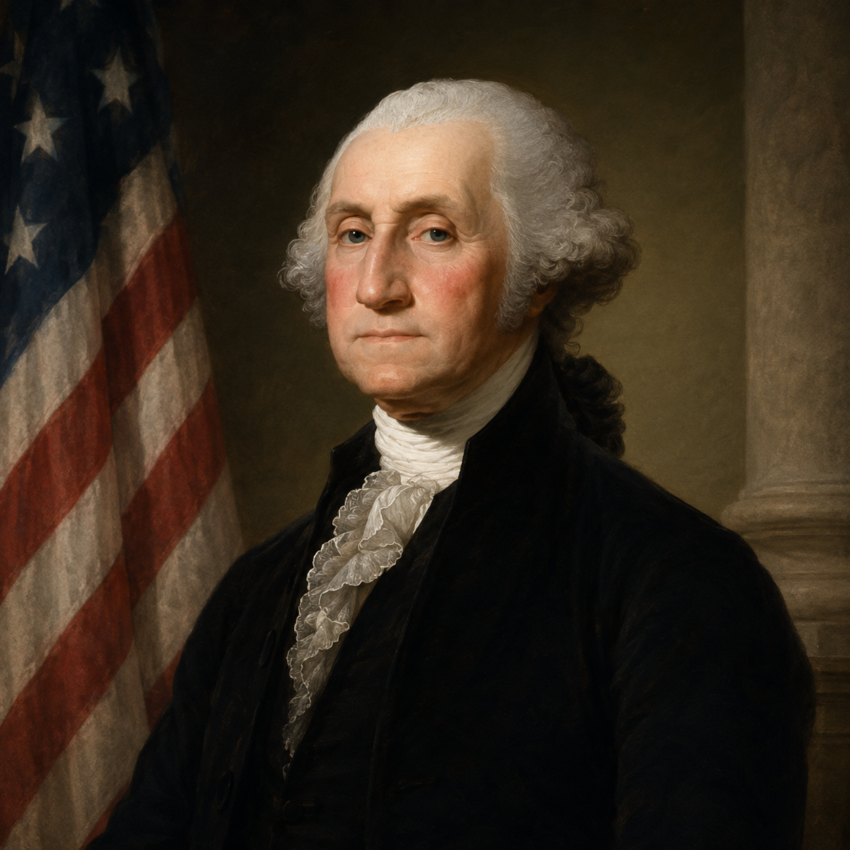
The portrait in the image above is part of the enormous visual legacy surrounding Washington.
Over the centuries, artists repeatedly portrayed him as the commander of the Revolution, the first president, and a central figure of the early republic.
His image eventually became one of the most recognizable in American history.
But behind the famous portrait was a complicated historical figure who lived during an equally complicated period.
Washington was a military commander, plantation owner, political leader, and enslaver. His life and legacy therefore contain achievements that shaped the United States as well as aspects of the period’s social and political system that remain subjects of historical study.
The Choice to Walk Away
Perhaps the most striking moment of Washington’s public life came not when he accepted power, but when he gave it up.
He had commanded an army.
He had become the country’s first president.
He could have attempted to remain at the center of American political life.
Instead, he returned to Mount Vernon after two presidential terms.
His Farewell Address became an enduring founding document, particularly for its discussion of national unity and the dangers of excessive political division.
More than two centuries later, Washington’s story remains woven into the history of the United States.
The portrait shows an older man in formal clothing.
But behind that face is the story of a young surveyor who became a soldier, a general who helped lead a revolution, a convention president who helped shape a new government, and the first person to occupy an entirely new office.
George Washington died in 1799, but the decisions made during his lifetime continued to influence the American republic long after he was gone.