When my daughter quietly said, “I miss you, Dad” into our old landline, something inside me shattered. Her father had supposedly been gone for eighteen years. At least, that was the story I had lived with all this time.
My husband, Victor, supposedly died when Mara was only two weeks old. We were told it was a terrible car accident. One minute, he was kissing my forehead before leaving to buy formula. The next, a police officer was at our door delivering news that changed everything.
I was only twenty-three, suddenly a widow with a newborn in my arms.
Victor’s mother, Irene, immediately took control. She arranged the funeral, handled the paperwork, and insisted on a closed casket and a quick cremation because of the condition of the body.
I was too devastated to question her.
I never saw Victor’s body. I simply accepted that he was gone.
For eighteen years, I carried that grief while raising Mara. She grew into a thoughtful young woman with Victor’s hazel eyes and some of his mannerisms. Every now and then, she would ask me what her father had been like.
I told her about his terrible jokes, his awful singing, and the little way he used to squeeze my hand twice whenever he wanted to silently say, “I love you.”
Then, one ordinary evening, everything changed.
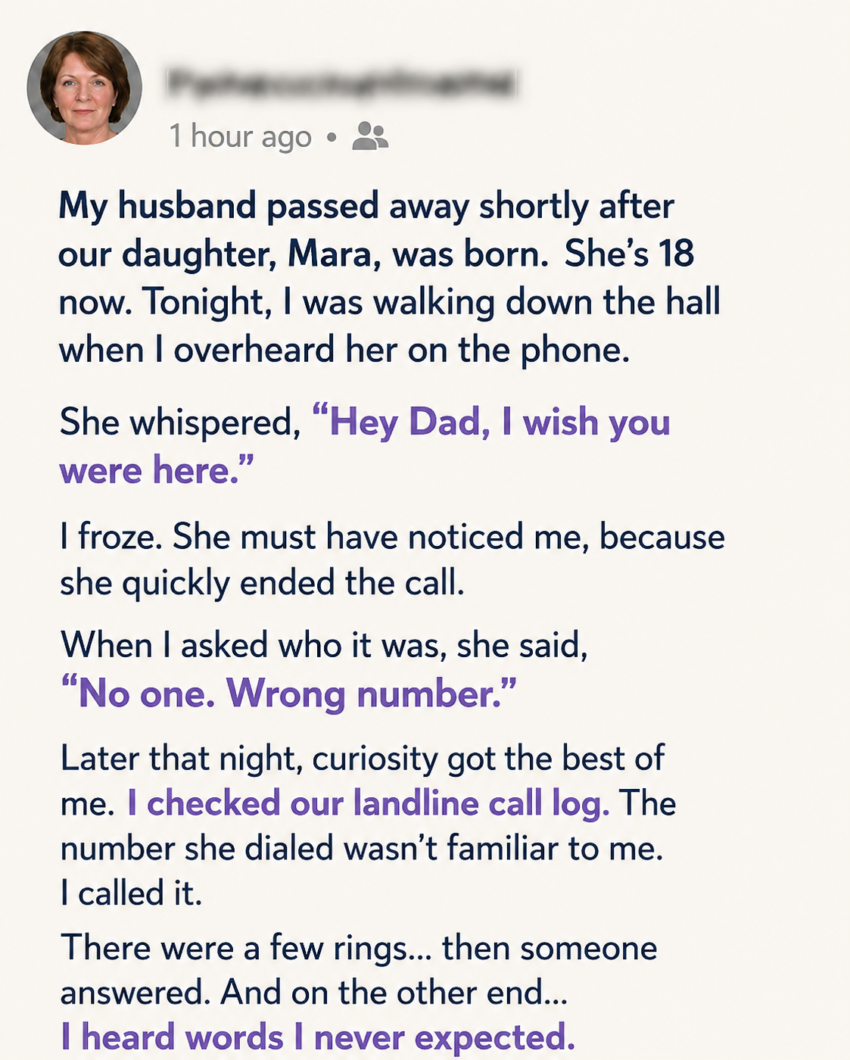
I was in the kitchen when I heard Mara speaking from the hallway.
Her voice was soft.
“Okay… I miss you too, Dad.”
I froze.
When she saw me, she immediately ended the call.
“Who were you talking to?” I asked.
“No one. Just a wrong number,” she replied before hurrying upstairs.
But something about her voice told me that wasn’t true.
Later that night, I checked the landline records. The same unfamiliar number appeared several times.
With trembling hands, I called it.
A man answered.
“Mara,” he said softly. “I didn’t think you’d call again tonight.”
His voice stopped me cold.
“Who is this?” I asked.
There was silence.
Then he hung up.
For the first time in eighteen years, I began questioning everything—the funeral, the cremation, the closed casket, and Irene’s insistence on taking care of every detail.
What if Victor had never died?
The next morning, I sat Mara down and asked her to tell me the truth.
She began crying.
Then she brought me an old envelope.
Inside was a letter written in handwriting I recognized immediately.
It was from Victor.
He claimed he was alive and explained that after Mara’s birth, he had panicked. He said Irene had helped him disappear and convinced him that staying away was the only way to protect everyone.
He admitted that he had watched Mara’s life from a distance and had recently found the courage to contact her.
Mara confessed that she had been secretly communicating with him for several months.
She had initially doubted the letter, so she searched for him online. When she found photographs, she recognized the resemblance.
She needed to know whether he was really her father.
And when she called, he answered.
Two days later, I contacted Victor myself.
“We need to talk,” I told him.
We met at a busy coffee shop.
When he walked in, I felt as if I were looking at a memory that had somehow come back to life. He was older, thinner, and visibly burdened by years of regret.
“You let me believe you were dead,” I said.
His eyes dropped.
“I know.”
“You let your daughter grow up without you.”
“I know,” he repeated. “I regret it every day.”
He explained that Irene had convinced him he would destroy our lives if he returned. Later, when he considered coming back, she allegedly warned him that revealing the truth could have serious consequences for her.
“And you chose to stay away,” I said.
He nodded.
“I was afraid. I was a coward. There’s no excuse.”
I told him that if he wanted a relationship with Mara, apologies alone wouldn’t be enough.
He would have to take responsibility for the eighteen years he had missed.
I gave him a private agreement covering the financial support he had never provided.
He looked at it for a long moment.
“I’ll pay,” he finally said.
After that, the decision would belong to Mara.
Over the following months, Victor kept his word. He made the payments without excuses and slowly began rebuilding a relationship with his daughter.
Their conversations started awkwardly. Eventually, they became longer and more natural.
They met in ordinary places—parks, cafés, and quiet library courtyards—creating new memories instead of trying to recreate the past.
Mara asked difficult questions.
Victor answered them.
Forgiveness didn’t happen overnight. But little by little, she began letting go of the anger she had carried for years.
I realized something too.
I hadn’t only been grieving Victor.
I had been grieving eighteen years built around a lie.
Victor wasn’t the hero of this story, and he wasn’t some mysterious villain either. He was a frightened, deeply flawed man who eventually chose to confront the damage he had caused.
Mara decided to give him a cautious place in her life.
I kept my boundaries.
And Victor slowly learned that being a father wasn’t about showing up once—it was about continuing to show up.
Sometimes the past doesn’t stay buried.
Sometimes, eighteen years later, it knocks on your door asking for another chance.
Whether you open that door is up to you.
I opened mine—not because I had forgotten what happened, but because my daughter deserved the chance to know the truth.