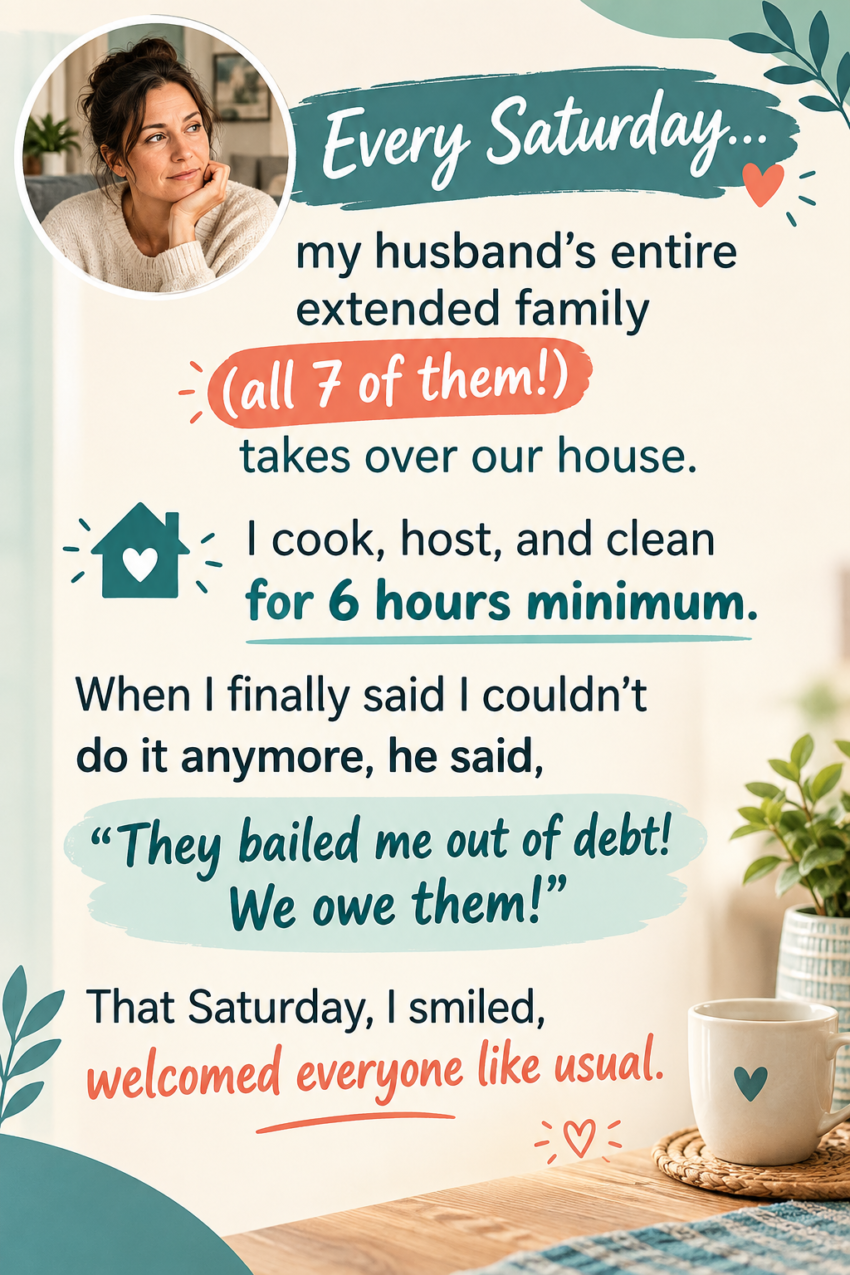
Every Saturday, my husband’s entire extended family came to our house.
Not occasionally.
Not once in a while.
Every single Saturday.
By ten in the morning, the doorbell would begin ringing.
First came his parents.
Then his aunt.
Then his cousin.
Then his younger brother.
And finally, his uncle—the man who somehow had an opinion about everything but never offered to help with anything.
Within an hour, our quiet home would be filled with people.
Shoes would be scattered across the hallway.
Conversations would take over the living room.
The television would be turned on.
And someone would eventually ask the question I had learned to expect.
“So, what are we having for lunch?”
Meanwhile, I would already be in the kitchen.
For the next six hours, I would barely sit down.
I prepared enormous meals from scratch.
I served everyone.
Refilled drinks.
Cleared plates.
Washed dishes.
Cleaned counters.
Swept the floors.
Prepared dessert.
Then cleaned everything again.
Nobody ever officially asked me to do all of it.
That was almost the strangest part.
It had simply become my responsibility.
They arrived.
They ate.
They relaxed.
And I worked.
For a long time, I didn’t complain.
There was a reason I had allowed it to continue.
Years earlier, my husband had lost his job.
Money had become extremely tight.
His family stepped in during that difficult period.
They helped us pay several bills.
They brought groceries.
They made sure we had enough to get through those months.
I never forgot that.
I was genuinely grateful.
But gratitude can become dangerous when other people start treating it like an unlimited debt.
Slowly, those Saturday visits became routine.
Then they became expected.
Eventually, nobody even asked whether we were available.
They simply showed up.
And somehow, the fact that they had once helped us became the reason I was expected to spend nearly every Saturday serving them.
I kept telling myself:
They’re family.
They helped us.
It’s only one day a week.
But one day a week became six hours of cooking and cleaning.
Then another Saturday arrived.
And I realized I was exhausted before anyone had even arrived.
The breaking point came on a Wednesday night.
I had just finished dinner when I walked into the kitchen and saw the sink full of dishes.
My hands were already sore from cleaning.
I stood there staring at the mess and suddenly wondered:
Why am I doing this every weekend?
That night, I finally talked to my husband.
“I can’t keep doing this every Saturday.”
He was sitting on the couch, looking at his phone.
He barely looked up.
“They helped us when we were struggling.”
“I know.”
“We owe them.”
I waited for him to say something else.
Maybe:
We’ll find another arrangement.
Or:
I’ll help you.
Or even:
Let’s talk to my family.
But he didn’t.
He simply repeated:
“We owe them.”
Something changed inside me.
Not loudly.
Not dramatically.
But permanently.
Because I suddenly realized something.
He wasn’t talking about himself.
He was talking about what I was expected to give.
My time.
My energy.
My weekends.
My work.
Apparently, all of that was part of the debt too.
I didn’t argue with him that night.
I simply went to bed.
And I made a decision.
The following Saturday, I did everything exactly as I always did.
I opened the door with a smile.
I welcomed everyone.
I prepared a huge lunch.
I made grilled meats, fresh side dishes, homemade desserts, and enough food for everyone to have seconds.
They praised the meal.
His aunt told me the dessert was delicious.
His mother complimented the seasoning.
His uncle asked for another serving.
Everyone seemed perfectly comfortable.
They had no idea that I had already decided this would be the last Saturday they treated me like unpaid staff.
When everyone had finished eating, I disappeared into the kitchen.
A few minutes later, I returned carrying a stack of neatly printed papers.
I walked around the table.
Then placed one sheet in front of every person.
Nobody understood what they were looking at.
My husband’s cousin picked up his paper.
His aunt adjusted her glasses.
His mother looked confused.
Finally, my husband asked,
“What is this?”
I smiled calmly.
“Since everyone enjoys spending Saturdays here so much, I thought we should make the arrangement a little more official.”
His eyebrows tightened.
“What are you talking about?”
I pointed toward the top of the page.
Printed in large bold letters were the words:
SATURDAY HOME SERVICE MENU
Underneath, I had listed everything I had been doing.
Meal preparation — fee
Private chef service — fee
Table service — fee
Dishwashing — fee
Kitchen cleanup — fee
General house cleaning — fee
Weekend hosting surcharge — fee
And at the bottom:
TOTAL SATURDAY SERVICE: TO BE DISCUSSED
The room became completely silent.
Nobody laughed.
My husband’s cousin started to smile awkwardly, then stopped when he realized no one else was laughing.
His aunt reread the page.
His mother slowly put hers on the table.
My husband stared at me.
“What is this supposed to mean?”
I looked directly at him.
“It means my time has value.”
He looked shocked.
“You’re serious?”
“Very.”
His aunt finally spoke.
“You’re actually charging your family?”
I shook my head.
“No. I’m showing you what you’ve been asking me to provide every single Saturday.”
Nobody answered.
For years, my work had been invisible.
Because I never complained.
Because I smiled.
Because I kept serving.
Because I never put a price on what I was doing.
But suddenly, when all those tasks were written down on a piece of paper, everyone could see just how much I had been giving.
And they didn’t like seeing it.
Then something happened that I never expected.
My husband’s aunt slowly pushed her chair back.
“Well…”
She looked around the room.
“I suppose we could help with the cleanup.”
She stood up.
Then picked up several plates.
His younger brother followed.
“I’ll take these to the kitchen.”
His cousin stood.
“Where do the trash bags go?”
His mother started gathering glasses.
Even the uncle who normally criticized everything finally got off the couch.
For the first time, I watched my husband’s family clean up after themselves.
Nobody had died.
Nobody had been insulted.
Nobody had been treated badly.
They simply had to participate.
I stood there for a moment, almost unable to believe what I was seeing.
Then I sat down.
For the first time during one of their Saturday visits, I sat down while everyone else worked.
And strangely enough, I didn’t feel guilty.
I felt relieved.
But the real argument didn’t happen until later.
Once everyone had left, my husband closed the front door.
Then he turned toward me.
“What was that?”
I knew exactly what he meant.
“The papers?”
“You humiliated me in front of my family.”
“I didn’t insult anyone.”
“You made them feel like they were taking advantage of you.”
I looked at him.
“They were.”
He became even more upset.
“They helped us when we were struggling!”
“And I’m grateful.”
“Then why would you do something like that?”
“Because being grateful doesn’t mean I have to spend every Saturday working for them.”
He shook his head.
“You could have handled this differently.”
“I tried.”
“When?”
“The night I told you I couldn’t keep doing this.”
He went silent.
I continued.
“You didn’t ask how I felt.”
“You didn’t offer to help.”
“You didn’t suggest changing anything.”
“You just told me we owed them.”
He looked away.
I took a breath.
“I never said your family couldn’t visit.”
“That isn’t the point.”
“Then what is?”
“The point is that I won’t spend six hours cooking and cleaning while seven other adults sit around and enjoy themselves.”
He called my behavior selfish.
Then disrespectful.
Then embarrassing.
But for once, I didn’t become emotional.
I didn’t cry.
I didn’t apologize.
I simply stood there.
And finally told him what I had been afraid to say for years.
“No.”
He looked at me.
“I don’t think what I did was disgusting.”
I paused.
“I think what’s wrong is expecting someone to work all day and pretending that work doesn’t count.”
He didn’t answer.
So I said the sentence that had been waiting inside me for a very long time.
“I’ve spent years acting like I’m invisible because it made everyone else comfortable.”
I looked around our kitchen.
“But I’m done doing that.”
The next Saturday was different.
Not because I refused to let anyone come.
But because the rules had changed.
When the doorbell rang, I opened it.
His family walked inside.
His aunt immediately asked,
“What should we bring into the kitchen?”
I smiled.
“Whatever you’d like.”
His younger brother carried drinks.
His cousin brought dessert.
His mother helped prepare the table.
His uncle actually washed dishes.
I almost laughed when I saw him standing at the sink.
My husband noticed too.
He came into the kitchen.
For a moment, neither of us said anything.
Then he quietly asked,
“Are you okay?”
I nodded.
“Yes.”
He looked around.
Everyone was helping.
“I guess we should have been doing this before.”
I didn’t say I told you so.
I didn’t need to.
He already understood.
A few weeks later, Saturday gatherings were no longer six-hour work sessions.
Everyone still visited.
We still ate together.
We still talked and laughed.
But I wasn’t the household employee anymore.
People brought food.
People cleaned.
People helped.
And if someone wanted something, they got up and got it themselves.
The biggest change wasn’t actually my husband’s family.
It was my husband.
He eventually admitted that he had confused gratitude with obligation.
His family had helped us during a difficult time.
That deserved appreciation.
But it didn’t give them ownership over my weekends.
And it certainly didn’t give him the right to decide that my labor was how the debt would be repaid.
I never regretted making that list.
Because I didn’t create it to embarrass anyone.
I created it because sometimes people don’t recognize the value of something until you put it right in front of them.
For years, everyone had seen the food.
They had seen the clean house.
They had seen the full table.
They had enjoyed every part of it.
But they hadn’t seen the woman behind it.
The woman who spent six hours making everything happen.
The woman who was exhausted.
The woman who rarely sat down.
The woman who kept smiling because she was afraid that saying no would make her look ungrateful.
That Saturday, I finally stopped hiding.
And once I did, everyone else finally noticed.
My husband once told me,
“We owe them.”
Maybe we did owe them gratitude.
Maybe we owed them appreciation.
But I finally understood something important:
Gratitude should never require you to disappear.
And family should never mean that one person has to carry the entire burden while everyone else enjoys the benefits.
I wasn’t asking them to pay me.
I wasn’t asking for special treatment.
I was simply asking them to recognize that my time mattered too.
And sometimes, the strongest boundary isn’t shouting.
It isn’t anger.
It isn’t walking away.
Sometimes, it’s calmly putting the truth on paper and letting everyone read it for themselves.
I wasn’t invisible anymore.
And I never planned to become invisible again.
THE END