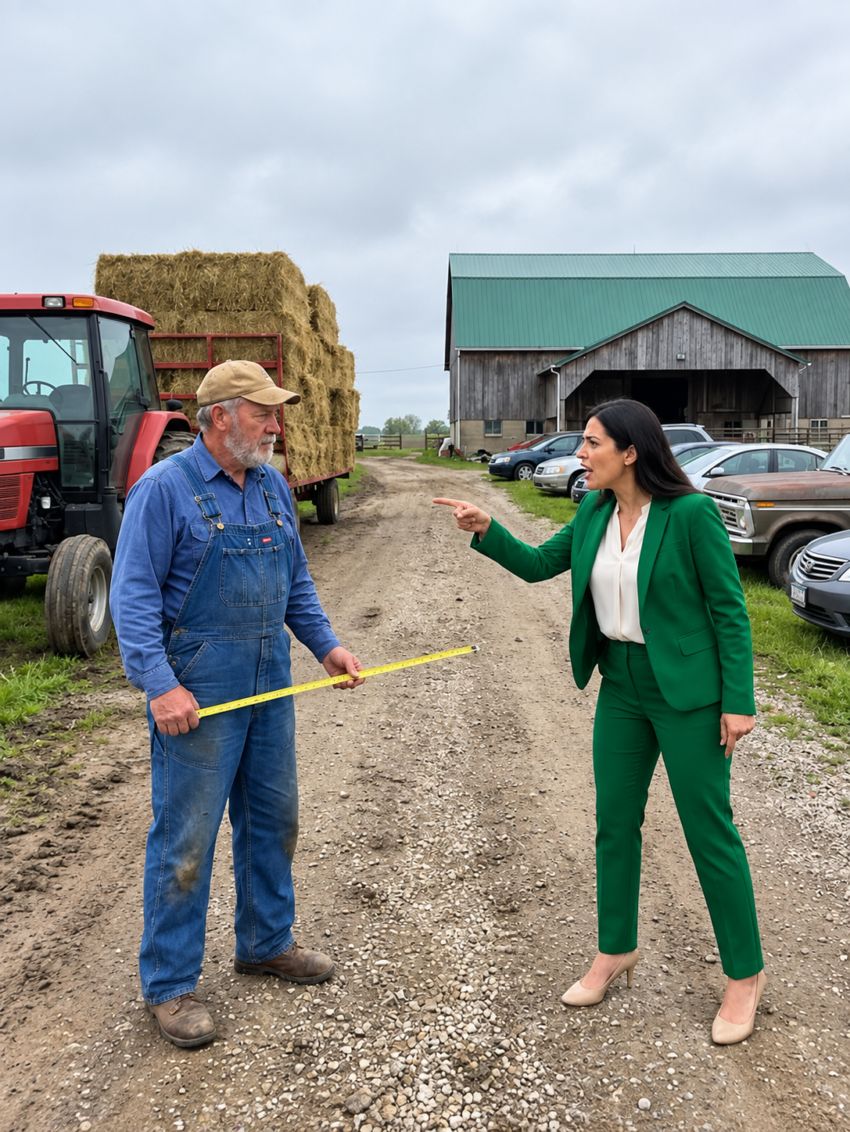
The contractor was unloading two red-and-white barricades when I saw Evelyn standing beside the clubhouse entrance, watching a county inspector write something across the hood of his pickup.
She looked furious.
For nearly two weeks, she had told everyone in Ridgeview Estates that I was the unreasonable one.
According to her, I was the farmer causing problems.
I was supposedly interfering with emergency access.
I was supposedly refusing to cooperate with the neighborhood.
I was supposedly putting residents at risk because I insisted on using my own farm road for my own equipment.
Now a county order was being attached to a barricade.
And the road being closed wasn’t mine.
It was Ridgeview’s.
A notice was secured to the center barricade:
ROAD CLOSED — UNAPPROVED CONNECTION
Residents could still use the main entrance.
Nobody was trapped inside.
Nobody had lost access to their homes.
The clubhouse was still standing.
What had disappeared was the shortcut Evelyn had created across my property.
But to understand how we got there, I need to take you back to the beginning.
Because the barricades were only the final chapter.
The real damage had started weeks earlier.
My family has owned our farm for three generations.
My grandfather cleared much of the eastern forty acres before there was even a paved road nearby.
My father took over the property and eventually built the concrete culvert crossing that connected the main road to our fields.
Back then, there was nothing around us except farmland.
No expensive homes.
No clubhouse.
No HOA.
Just fields, barns, fences and dirt roads.
Then Ridgeview Estates was developed on the neighboring property.
The developers approached my father during construction.
They wanted an emergency route across one corner of our land.
Their main entrance was on the other side of the subdivision, and the county fire marshal wanted a secondary route available in case the primary entrance became blocked.
My father agreed.
But he didn’t simply shake hands and forget about it.
The agreement was recorded at the county courthouse.
It created a twenty-foot-wide emergency corridor across our culvert.
Fire trucks.
Ambulances.
Emergency evacuation.
That was it.
The easement wasn’t a general driveway.
It wasn’t a parking area.
It wasn’t an extension of the clubhouse.
And it certainly wasn’t permission for neighborhood guests to park on our farm road.
My father understood exactly what he was agreeing to.
He believed that if his neighbors ever needed an emergency route, they should have one.
For almost twenty years, the easement caused no problems.
The occasional fire department drill used it.
Once or twice, emergency vehicles crossed the property.
Most of the time, the road was used by me and my farm equipment.
Then Evelyn Draper became Ridgeview’s HOA manager.
That’s when things slowly started changing.
At first, I barely noticed.
I later learned that the HOA had created an internal map showing something called a “shared access apron.”
According to that map, the clubhouse’s access area extended farther south than it actually did.
It crossed the area around my culvert.
I had never approved the map.
I’d never signed anything giving Ridgeview control over that land.
But Evelyn treated the HOA map as though it carried the same authority as a recorded property document.
The first problem was a single vehicle.
One Saturday, a guest parked near the crossing because the clubhouse lot was full.
I called Evelyn.
“That’s part of my farm road,” I explained.
She apologized.
She said it wouldn’t happen again.
The following weekend, it happened again.
Then there were two vehicles.
Then three.
By the third or fourth weekend, someone had painted parking lines.
Actual white parking spaces.
Six of them.
Right across the entrance to my culvert.
Then came the wheel stops.
Someone drilled them into the ground near the headwall my father had built decades earlier.
At that point, I stopped making polite phone calls.
I sent Evelyn a certified letter.
I explained that the area was private property.
I explained that the recorded easement was limited to emergency access.
I explained that hay season was approaching.
And I told her that my equipment needed the full width of the crossing.
I asked her to remove the parking markings and barriers.
She never answered the letter.
Instead, the cars kept coming.
Then the weather forecast changed.
A major storm was expected.
My round bales were still sitting in the west field.
I had to bring them in before the ground became too soft.
When I drove toward the culvert that Thursday afternoon, I found six SUVs sitting neatly inside the freshly painted spaces.
A catering truck was approaching another vehicle.
My hay wagon couldn’t fit.
Even the tractor would have had trouble making the turn without dropping a tire into the ditch.
I sat in my truck for several seconds.
I was angry.
But I knew getting angry wasn’t going to solve anything.
So I called Evelyn.
No answer.
I drove to the clubhouse.
I found her standing near the access road with a folder under her arm.
A contractor was nearby setting out more cones.
“Evelyn,” I said. “I need this crossing open.”
She looked at me.
“The clubhouse has an event.”
“Rain is coming. I have hay in the field.”
“You’ll have to use another route.”
“The other route isn’t wide enough for my wagon.”
She opened the folder.
“This is association access.”
“No. It’s a recorded emergency easement.”
She held up a printed map.
“Our records show shared access.”
“I have the recorded deed.”
Her expression hardened.
“We have an HOA map showing association control.”
“A private HOA map doesn’t override a recorded easement.”
She didn’t like that answer.
Then she said something that bothered me even more.
She claimed my farm equipment was interfering with emergency access.
I looked at the contractor.
Then at Evelyn.
“You’re telling me my tractor is the problem?”
“If you try to move equipment through here while residents are parked, you could cause an accident.”
I realized what she was doing.
If something went wrong, she wanted the responsibility to land on me.
So I stopped arguing.
I went home.
My father kept old property documents in a fireproof box.
I opened it that night.
Inside were deeds, surveys, tax records and the original easement.
I found it.
I made three copies.
One stayed with me.
One went to Ben Holloway, a surveyor I’d trusted for years.
The third would eventually go to the county.
I read the easement again.
Then I read it a second time.
The language was clear.
Ridgeview had a right of emergency ingress and egress across a twenty-foot corridor.
The purpose was specifically tied to emergency use.
Fire.
Rescue.
Evacuation.
It did not grant ordinary vehicle access.
It did not authorize clubhouse parking.
It did not allow the HOA to install wheel stops.
And it did not give Ridgeview ownership of the crossing.
The funny thing was that Evelyn had been relying on the existence of the easement to justify her actions.
But the easement itself defined exactly how limited their rights were.
She was standing on the one document that proved her interpretation was wrong.
Ben came out the following morning.
He didn’t take sides.
That’s one reason I trusted him.
He measured.
He located the property boundary.
He marked the twenty-foot emergency corridor.
Then he placed survey stakes so anyone standing there could see exactly where the easement ran.
The result was obvious.
The painted parking spaces weren’t simply inconvenient.
Most of them were outside the actual emergency corridor.
They were sitting on my property.
I sent Evelyn another letter.
This time I included:
The recorded easement.
Ben’s survey notes.
Photographs.
Measurements.
And a request that the vehicles and wheel stops be removed before the storm.
I copied the county fire marshal’s office.
After all, the emergency corridor existed because of their original safety concerns.
I thought that might finally settle the matter.
It didn’t.
Evelyn replied within hours.
But instead of removing the vehicles, she sent an email to the entire Ridgeview resident list.
She described me as an uncooperative property owner.
She said I was challenging the neighborhood’s shared rights.
She implied that my actions could interfere with emergency response.
I read the email twice.
I couldn’t believe she had turned a simple property dispute into a public accusation.
So I called the fire marshal’s office.
I explained everything.
The recorded easement.
The painted spaces.
The wheel stops.
The blocked farm road.
The notices I’d already sent.
The upcoming storm.
The official who answered the phone told me something interesting.
Evelyn had already contacted them.
But apparently she’d described the issue as a routine parking disagreement.
She hadn’t mentioned that an emergency corridor was being physically obstructed.
That was when the county decided to inspect the site.
The inspection happened several days later.
A county official arrived with a fire department representative.
They examined the crossing.
They looked at the painted parking spaces.
They inspected the wheel stops.
They compared the actual property layout with the approved Ridgeview development plans.
Evelyn arrived with her folder.
I stayed quiet.
The inspector asked her:
“Who approved these parking spaces?”
She said the HOA had determined the area was shared.
The inspector looked at the site plan.
“This isn’t shown here.”
Evelyn pointed toward her map.
“Our internal records show the access apron.”
The inspector shook his head.
“I’m asking about the approved plan.”
She didn’t answer.
He examined the emergency corridor.
Then he looked toward the clubhouse connector.
“Where is this connection shown?”
Again, no answer.
That’s when the fire official stepped forward.
“This route was originally intended as emergency access only.”
Evelyn insisted that the association had legitimate access rights.
The inspector replied calmly:
“Emergency access does not automatically mean general parking.”
She didn’t seem to understand.
Or perhaps she simply didn’t want to.
Then the inspector discovered something else.
Ridgeview’s primary entrance had been modified years earlier.
A drainage structure had been changed during a road improvement project.
The alteration had never been properly documented.
That mattered.
Because the county had originally required the emergency easement as a backup route in case the main entrance became unsafe or inaccessible.
The inspector studied the plans.
“If this primary entrance isn’t compliant,” he said, “then the secondary emergency route becomes even more important.”
Evelyn’s face changed.
The same easement she’d been using to justify parking had just become the reason the county needed that road kept completely clear.
The county issued its order.
Ridgeview had to stop using the clubhouse connector until the unauthorized use was corrected.
The parking spaces had to disappear.
The wheel stops had to be removed.
The damaged shoulder had to be repaired.
The emergency corridor had to remain open.
And the clubhouse connection had to be brought into compliance before it could be used again.
That’s when the barricades went up.
Exactly like I described at the beginning.
Evelyn stood beside them, watching the county inspector attach the notice.
She finally looked at me.
“You’re closing an HOA road because of a private property complaint?”
The inspector answered before I could.
“No.”
He pointed to the order.
“We’re closing an unauthorized connection because it isn’t shown on the approved plan, it obstructed required clearance, and the use continued after notice.”
That sentence ended the argument.
Especially the final part.
The use continued after notice.
If Evelyn had stopped the first weekend, none of this would have happened.
If she had removed the parking after my first letter, it could have been dismissed as a misunderstanding.
If she had stopped when I produced the easement, she could have said she was reviewing the documents.
But she kept going.
Cars kept arriving.
The wheel stops remained.
The parking spaces stayed painted.
Even after she had been shown the recorded easement, she continued directing people toward the crossing.
That transformed the situation.
It wasn’t simply a mistake anymore.
There was now a documented pattern of ignoring warnings.
And I had documented everything.
Once the barricades went up, I walked across the culvert with Luis.
We noticed damage that hadn’t been there before.
The wheel stops had left drilled holes.
Some gravel had been pushed into the drainage channel.
The shoulder near the headwall had been disturbed by vehicles and trailers trying to maneuver into the parking spaces.
Nothing had collapsed.
Nothing dramatic had happened.
But damage didn’t have to be dramatic to be real.
Ridgeview hired an engineer.
Thankfully, the concrete culvert itself was sound.
My father’s work had held up.
The engineer recommended straightforward repairs.
Replace the disturbed gravel.
Restore the shoulder.
Seal the anchor holes.
Remove the parking markings.
Restore the crossing to its original emergency-access configuration.
I was satisfied with that.
I didn’t want some exaggerated report claiming the entire bridge had nearly collapsed.
That wasn’t true.
I wanted the facts.
Nothing more.
Nothing less.
The storm eventually arrived.
We had already moved some hay using the narrow eastern route.
It took much longer than usual.
Luis made trip after trip with the smaller trailer.
Fuel costs increased.
Labor hours increased.
The work that normally took a day stretched across several.
But eventually, the county cleared the crossing.
The first time I brought the full-size hay wagon through again, Luis walked beside it.
We both checked the road.
No SUVs.
No cones.
No parking attendant.
No wheel stops.
Just the road.
Exactly as it had been before.
The wagon passed easily.
I felt a strange sense of relief.
Not because I’d beaten anyone.
Because I could finally do my job again.
Ridgeview’s board eventually held a special meeting.
By then, several board members had begun asking questions about Evelyn’s decisions.
They reviewed everything.
My original notice.
The recorded easement.
The survey.
The contractor’s correspondence.
The approved site plan.
The county’s inspection report.
And Evelyn’s emails.
One contractor email became especially important.
Before the parking lines were painted, the contractor had asked Evelyn whether the association had proper authorization for the area.
He had even asked whether county approval was required.
Evelyn responded:
“The HOA map shows association control through the shared access apron. Proceed before the weekend event.”
That sentence changed the board’s view of the situation.
The contractor had asked the right question.
Evelyn had given him the wrong answer.
And she had relied on an internal map instead of checking the recorded property documents.
The board didn’t accuse her of anything beyond what the records supported.
They simply removed her from overseeing the correction.
Later, her management company wasn’t renewed when its contract expired.
The HOA eventually paid for the documented repairs.
They also reimbursed the additional labor and fuel costs I could actually prove.
I had kept receipts.
Fuel records.
Luis’s work hours.
Trailer mileage.
I didn’t ask for anything I couldn’t document.
I wasn’t interested in turning a property dispute into a lottery ticket.
The actual damage was enough.
The shoulder needed repairs.
The wheel-stop holes needed sealing.
We had spent extra money hauling hay around the blocked crossing.
Those were the facts.
Those were the costs.
That’s what I accepted.
Eventually, Ridgeview submitted a proper plan for additional parking.
The new spaces were placed on land the HOA actually controlled.
They went through drainage review.
The county approved the design.
The emergency corridor remained open.
New signs were installed on both sides of the crossing:
EMERGENCY ACCESS — NO PARKING
Simple.
Clear.
Impossible to confuse with an HOA parking map.
The clubhouse connector received a proper emergency gate.
Fire personnel had access.
Ordinary guests did not.
And the emergency easement remained exactly where my father had placed it decades earlier.
I never asked for it to be removed.
I never wanted it removed.
If Ridgeview ever needed that route because of a fire, accident or blocked entrance, I wanted the emergency vehicles to be able to use it.
That was why my father granted it.
That was the part of the agreement worth protecting.
A few weeks later, I saw Marie Keen, one of the Ridgeview board members, standing near the new gate with a coffee.
She waved.
I waved back.
Things had become strangely normal.
No arguments.
No angry emails.
No accusations.
Just neighbors going about their business.
One morning, Luis and I prepared another hay load.
He looked toward the clubhouse.
“Think they’ll try parking here again?”
I laughed.
“Not unless they want another meeting with the county.”
He smiled.
We drove toward the culvert.
The new gravel was darker than the old surface.
The sealed anchor holes were still visible if you knew where to look.
The old white parking lines were almost completely gone.
Only faint traces remained.
Like a reminder of something that had happened but no longer controlled the road.
Marie lifted her coffee as we passed.
I raised my hand from the steering wheel.
Then I drove across the crossing.
The wagon rolled smoothly behind me.
No cars blocked the path.
No cones.
No parking spaces.
No arguments.
Just my farm road.
Looking back, I never needed to tow a single SUV.
I never needed to threaten anyone.
I didn’t need to shout at the HOA manager or make a scene in front of the residents.
I needed three things:
The original document.
Accurate measurements.
And patience.
Evelyn had relied on an internal map.
I relied on the recorded easement.
She argued about what she believed the HOA controlled.
I brought the actual property records.
She said the access was shared.
The document showed exactly how limited that access was.
And eventually, the county confirmed it.
The strangest part was that the very easement she used to justify her actions ended up being the strongest evidence against them.
My father had granted Ridgeview a narrow right for emergencies.
Nothing more.
He never gave them permission to turn our farm road into a parking lot.
He never gave them the right to install barriers.
And he certainly never gave them control of our property.
The emergency route stayed.
The parking lot disappeared.
The culvert was repaired.
The hay eventually made it into the barn.
And the road went back to doing what it had done for decades.
Carrying my farm equipment from one field to another.
Quietly.
Reliably.
Without asking anyone’s permission.
Because sometimes, when people argue loudly enough about what they think they own, the best response isn’t louder.
It’s opening the original paperwork and letting the record speak for itself.