My husband created our flower garden in the summer of 1997.
He never asked whether I wanted one.
One Saturday morning, Roy pulled into our driveway with his truck loaded with bags of soil, gardening equipment, and trays filled with red and yellow flowers. From the way he moved everything around, I could tell this wasn’t a spontaneous idea. He had clearly been planning it for some time.
I stood on the porch watching him.
Roy was fifty-three that summer.
He still had the same familiar face I had fallen in love with when we were young, although the years had changed him in subtle ways. He moved more deliberately, wasting very little energy. Every task seemed carefully considered.
He spent almost the entire day working.
By around six in the evening, he finally walked up the porch steps and stood beside me.
We looked across the yard together.
From the street, the flower bed looked simple and natural.
But from where we stood, I could see how carefully he had arranged everything. Red flowers curved into yellow ones, creating a pattern that looked almost effortless.
The afternoon sunlight caught the petals and made the whole garden glow.
“Roy,” I said.
He looked at me.
“Do you like it?”
“Why did you choose red and yellow?”
He smiled.
“Because those are the flowers I always bring you.”
That was Roy.
He could say something incredibly meaningful in the simplest possible way.
It was the same quiet smile he had worn when I first met him at a church gathering in 1968.
Every anniversary, he brought me red and yellow flowers.
He did it for forty-one years.
I looked back at the garden.
“It might be the most beautiful thing anyone has ever done for me.”
Roy shrugged.
“It’s just a garden.”
“No,” I told him. “It isn’t.”
And somehow, I knew he understood exactly what I meant.
Roy died in March 2011.
He was sixty-seven.
Even now, that number sounds too young.
I suppose there is no age at which losing someone you love feels acceptable.
If he had lived to seventy-five, I would have wanted eighty.
If he had reached eighty, I would have wished for ninety.
There would always have been another birthday I wanted with him.
He was still completely himself near the end.
He made Saturday plans.
He noticed things around the house that needed fixing.
He smiled that slow, familiar smile whenever I caught him watching me.
His heart stopped while he was working in the garden.
It was a Saturday morning.
The same place where he had spent countless Saturday mornings before.
The doctors told me he hadn’t suffered for long.
Years ago, I decided to believe them.
After Roy was gone, I continued maintaining the garden.
I couldn’t preserve it perfectly. No one can.
Flowers die.
Seasons change.
Soil gets tired.
Plants have to be replaced.
But every spring, I recreated the same design.
Red.
Yellow.
That familiar curved pattern Roy had created in 1997.
Each year, I spent an afternoon kneeling in the soil, arranging the flowers as closely as possible to the way he had planted them.
And whenever I finished, I would stand back and look at the garden.
For a moment, it almost felt as though he were nearby.
Not literally.
I wasn’t confused about that.
But when you repeat the same little traditions with someone you love for decades, those routines can become powerful reminders after they’re gone.
The garden wasn’t expensive.
Every spring, I probably spent forty or fifty dollars on flowers, soil, and fertilizer.
Financially, it wasn’t worth much.
Emotionally, it was priceless.
It represented decades of memories, love, and time.
My name is Eleanor Marsh, although most people on the street call me Ellie.
Roy gave me that nickname many years ago.
Like so many things connected to him, it stayed with me after he was gone.
I was seventy-one and had lived in the same house for twenty-nine years.
I knew almost everyone nearby.
I knew which families had lived there the longest, which houses had changed owners, who walked their dogs each morning, and which children I had watched grow from bicycle riders into licensed drivers.
And I knew the Hausers.
Dennis Hauser lived three houses away.
He had been there for around twelve years.
Dennis was successful.
He owned interests in commercial real estate, restaurant supply businesses, and a few other ventures I never fully understood.
Whatever he did, it had made him wealthy.
He drove an expensive silver car and had the relaxed confidence of someone who had rarely needed to worry about money.
Dennis himself wasn’t particularly unpleasant.
His property was always neat.
He kept things quiet.
He waved when we passed.
Once, after a storm dropped a large branch into my yard, he sent someone from his landscaping crew to remove it without me even asking.
Then his son Kyle came home from college.
Kyle was twenty-two.
And it didn’t take long for me to notice that he had been raised to expect very few consequences.
He wasn’t spoiled simply because his parents had money.
There is nothing wrong with giving a child opportunities.
The problem was that Kyle seemed to have received plenty of privileges without learning the responsibility that should accompany them.
He was loud because nobody had successfully told him to stop.
He was careless because other people usually cleaned up afterward.
And he had an expensive motorcycle.
He rode it like the neighborhood was his personal track.
For most of the summer, everyone tolerated him.
Not because we enjoyed it.
Because confronting someone can sometimes create more trouble than remaining silent.
Dennis had money and local connections.
Mrs. Patterson once complained to him after Kyle blocked her driveway late at night.
Dennis apologized.
Kyle repeated the behavior.
The Nguyen family complained about him cutting across their lawn.
Eventually, they stopped.
I watched.
I remembered.
And I kept records.
Roy used to tease me about having an “auditor’s brain.”
He meant it affectionately.
I tend to observe things before acting.
I notice patterns.
I wait until separate incidents begin to form a clear picture.
By the end of that summer, Kyle’s pattern was obvious.
Something was eventually going to happen.
I just never imagined that the thing he damaged would be mine.
It happened on a Saturday afternoon near the end of September.
My flower garden was still beautiful.
The light had begun to take on that softer autumn quality, but the first frost hadn’t arrived.
The red and yellow flowers were still blooming.
I was making tea when I heard Kyle’s motorcycle.
The engine grew louder.
Much louder than it should have been.
He was approaching the corner too quickly.
By the time I reached the window, I knew there was going to be trouble.
Kyle came around the corner at an unsafe speed.
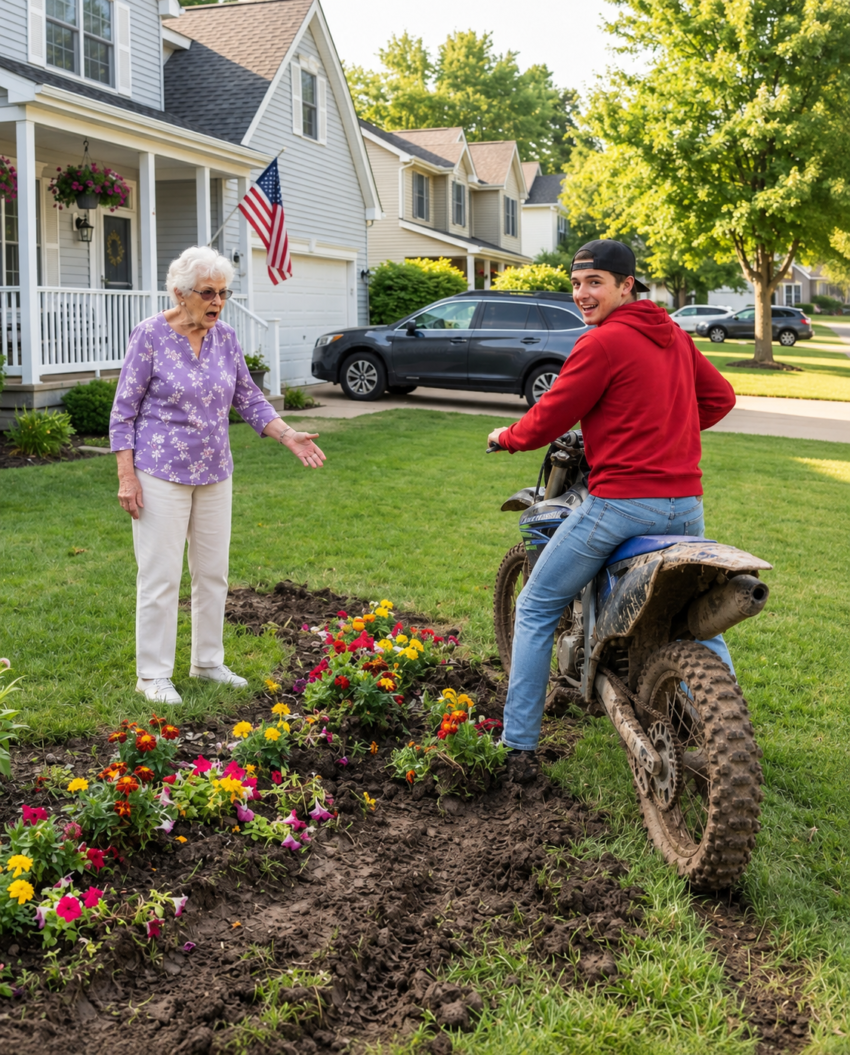
Instead of staying on the street, he cut across my front lawn.
It happened incredibly fast.
The motorcycle tire ripped through the flowers.
Soil flew into the air.
Several plants were crushed beneath the wheel.
Others were torn completely out of the ground.
And the curved design Roy had created nearly thirty years earlier was suddenly broken by a muddy track.
I put down my tea and went outside.
Kyle had stopped near his driveway and was removing his helmet.
I walked toward the edge of my property.
“Those flowers belonged to my husband,” I said. “He passed away.”
Kyle glanced toward the garden.
He saw the tire marks.
He saw the flattened flowers.
Then he shrugged.
“It’s just grass and flowers. They’ll grow back.”
No apology.
No concern.
No attempt to understand why the garden mattered.
There wasn’t even any obvious anger behind his words.
Somehow, that made it more painful.
Someone who deliberately hurts you at least understands that they’ve caused pain.
Kyle didn’t even recognize that anything important had been destroyed.
To him, they were simply plants.
He couldn’t see what I saw.
He couldn’t see Roy hauling bags of soil around the yard in 1997.
He couldn’t see forty-one anniversaries.
He couldn’t see the Saturday morning in 2011 when Roy went into the garden and never came back inside.
To Kyle, it was simply a flower bed.
Across the street, Janet stood on her porch.
She had witnessed everything.
Our eyes met.
Then she quietly went back indoors.
Kyle noticed.
He gave me a small, dismissive smile.
Then he went inside.
I didn’t shout.
I didn’t threaten him.
I walked back into my house and closed the door.
For several minutes, I stood in the kitchen thinking.
The motorcycle had damaged roughly three feet of the garden.
Seven or eight plants were destroyed.
The southern curve of the arrangement was badly disturbed.
Kyle had admitted what he had done.
He had offered no apology.
Instead, he told me the flowers would grow back.
I walked over to the desk in my living room and opened a drawer.
Inside was a folder I had started several months earlier.
Because I notice things.
And Kyle had given me plenty to notice.
Dates.
Times.
Photographs.
Descriptions.
I had been documenting his behavior since June.
Not because I wanted revenge.
By August, I had simply realized that eventually I might need more than a conversation with a neighbor.
I picked up my phone and called Patricia Delgado.
Patricia was an attorney who worked with a local firm handling property and neighborhood disputes.
A friend had recommended her.
Patricia had a reputation for making people realize, often halfway through a meeting, that they hadn’t thought their situation through nearly as carefully as she had.
She answered quickly.
“Mrs. Marsh. What happened?”
I explained everything.
The motorcycle.
The garden.
The damage.
Kyle’s response.
She listened carefully.
Then she asked, “Do you have photographs?”
“Yes.”
“Take more immediately. Before anything changes.”
“I will.”
“Anyone witness it?”
“Janet Kowalski. She lives across the street.”
Patricia paused.
“There are two separate issues here,” she said.
I waited.
“The damage itself is relatively simple. The cost of replacing the plants and repairing the lawn probably isn’t substantial.”
“I understand.”
“But your documentation of his previous behavior could be much more important.”
I knew exactly what she meant.
She asked me to organize everything by date and mark which incidents had photographs or witnesses.
“I’ve already done that,” I told her.
She laughed softly.
“Of course you have.”
Then she said something unexpected.
“There may be another approach.”
“What approach?”
“Not every solution has to involve filing a lawsuit.”
She explained that people like Kyle often behaved badly because everyone around them remained silent.
One person tolerated the noise.
Another ignored the blocked driveway.
Someone else overlooked the damaged lawn.
Eventually, bad behavior became normal because nobody wanted the hassle of confronting it.
“But if several neighbors speak together,” Patricia said, “the situation changes.”
She knew someone who worked in community mediation.
That person had connections with the city council office and local media.
A repeated neighborhood problem could become a documented community issue rather than a private disagreement between two households.
Dennis’s reputation mattered.
He served on local boards and had several business interests.
A complaint over a few flowers probably wouldn’t concern him.
But a documented history of neighborhood complaints might.
“I understand,” I said.
“Let me make some calls.”
I thanked her.
Before hanging up, she paused.
“Mrs. Marsh?”
“Yes?”
“I am sorry about the garden.”
That meant something to me.
“Thank you.”
I went outside with my phone and photographed the damage.
I took wide photographs.
Then close-ups.
The tire marks.
The broken stems.
The crushed flowers.
The damaged curve in the design.
Then I compared those pictures with the ones I had taken earlier in the summer.
After that, I organized everything on my computer.
June 15.
Kyle’s motorcycle parked along the edge of the Nguyen family’s lawn.
June 22.
His motorcycle blocking Mrs. Patterson’s driveway close to eleven at night.
July 8.
Kyle revving the engine late at night.
There were other incidents.
July.
August.
September.
Dates.
Times.
Descriptions.
Photographs.
By then, the file was surprisingly large.
Patricia called the next morning.
She had already spoken with several people.
“There are local ordinances concerning residential noise and interference with property,” she explained. “Your records appear to establish a pattern.”
The city council member’s office was willing to receive a formal complaint.
A local newspaper’s community reporter was also looking into neighborhood quality-of-life complaints.
The situation could be discussed as a broader community issue rather than a personal dispute.
“It doesn’t necessarily need to become a story about Kyle,” Patricia said. “The larger pattern may be more important.”
Then she mentioned Dennis.
“He’s involved with the chamber of commerce. He has a lot of business connections around town. Public records tend to get people’s attention.”
There was another detail.
Patricia had checked Kyle’s motorcycle permit.
An incident from when he was eighteen had resulted in certain restrictions.
Some behavior in residential areas could potentially violate those conditions.
“That part is for the traffic division,” she said.
Then she added:
“I know someone there.”
“Patricia.”
“Yes?”
“You’ve been busy.”
“You retained me,” she replied. “I like to earn my fee.”
I smiled.
“What do you need?”
She wanted me to sign the formal complaint.
She also wanted to place a notice near my property.
It wouldn’t be threatening.
It would simply state that recent incidents involving the property were being formally documented and that any future damage could become part of a legal claim.
“In other words,” she said, “Kyle will see it when he comes outside.”
“I understand.”
The notice arrived around nine that morning.
Someone from Patricia’s office placed it near my walkway.
The wording was simple.
Recent property incidents were under formal review.
Any additional damage would be documented and could result in further action.
Legal counsel had been retained.
Every word was accurate.
I returned to my kitchen and made another cup of tea.
At 10:15, Kyle walked outside.
He wore his motorcycle jacket.
He headed toward the driveway while looking at his phone.
Then he noticed the notice.
He stopped.
Read it.
Then read it again.
Finally, he looked directly toward my house.
There was no apology on his face.
Only surprise.
He had apparently expected yesterday’s incident to disappear as soon as it was over.
It hadn’t.
All summer, Kyle had relied on everyone staying quiet.
This time, someone had broken that silence.
I watched from inside without letting him see me.
He eventually went back into his house.
About twenty minutes later, Dennis came outside.
He read the notice.
He looked toward my house for a long moment.
Then he went back inside.
About forty minutes after that, he knocked on my door.
“Mrs. Marsh.”
“Dennis.”
“I’d like to talk about the notice.”
“Certainly.”
He stood carefully, keeping his hands at his sides.
“I understand there was an incident yesterday.”
“Yes.”
“Kyle told me this morning.”
“Did he?”
Dennis nodded.
“He realizes what he did wasn’t appropriate.”
I noticed his choice of words.
Not “wrong.”
Not “disrespectful.”
“Appropriate.”
It sounded like the language of someone accustomed to resolving difficult situations without admitting too much.
“I’d like to replace the flowers,” he said. “I’ll cover the cost.”
“Yes,” I replied.
He looked surprised.
“You will?”
“You just offered.”
“I know.”
He waited.
“Mrs. Marsh, I don’t think we need to make this more complicated.”
“The flowers aren’t the biggest issue.”
His expression changed.
“I don’t understand.”
“Have you heard from the city council office?”
“No.”
“You probably will.”
I explained the complaint.
Then I mentioned that Patricia was contacting the traffic division about Kyle’s permit conditions.
Dennis went silent.
“Permit conditions?”
“There was an incident when he was eighteen. Your attorney can explain the details.”
“I’m sure we can resolve this without involving—”
“I know you believe that.”
Then I explained what had happened throughout the summer.
The blocked driveways.
The damaged lawns.
The nighttime engine noise.
The other incidents.
“I have photographs,” I said.
Dennis looked at me.
“Photographs?”
“Since June.”
He didn’t respond.
“The garden was created by my husband,” I continued.
“I heard about that. I’m sorry.”
“He planted it in 1997. I’ve cared for it since he died.”
Dennis looked toward the window.
“And yesterday, your son drove through it and told me the flowers would grow back.”
He didn’t answer.
“And he was right,” I said.
Dennis looked confused.
“They will grow back. I’ll plant new ones next spring.”
“Then what’s the problem?”
“The complaints.”
I explained that the city could review the incidents.
The traffic division could examine the permit.
The council member could speak with the neighbors.
And the newspaper could decide what to publish.
“None of those things depends on what happens between you and me anymore.”
Dennis finally asked:
“What do you want?”
“Kyle.”
He looked surprised.
“I want him to come here.”
“I’ll send him over.”
“No.”
Dennis frowned.
“Then when?”
“When he actually means what he says.”
He looked at me as if I had requested something unreasonable.
“You have an attorney, the city, and potentially the newspaper involved. You just want an apology?”
“A genuine one.”
“Not something you force him to say.”
Dennis stood quietly.
“What makes you think he’ll apologize?”
“I don’t know if he will.”
That was the truth.
“But nothing you offer me matters as much as him understanding what he did.”
Dennis looked toward the damaged garden.
“And the flowers?”
“I’ll replace them.”
“They won’t be exactly the same.”
“No.”
I looked outside.
“But they’ll still be Roy’s garden.”
“And Kyle?”
“That choice belongs to him.”
Dennis stayed quiet for a while.
Then he said something I wasn’t expecting.
“I owe you an apology too.”
His voice sounded less formal now.
“I knew about the noise,” he admitted.
“And the blocked driveways.”
“I kept telling myself Kyle was only home temporarily and would eventually settle down.”
He looked uncomfortable.
“It was easier to ignore it than to confront him.”
I nodded.
“I’m sorry, Mrs. Marsh.”
“Thank you.”
Dennis left.
Three days later, the city council member arrived with a staff member.
They walked through the neighborhood.
At first, I was the only person outside.
Then Janet came out.
Then the Nguyens.
Then Mrs. Patterson.
Eventually, several other neighbors joined us.
One by one, they described similar experiences.
Noise.
Blocked driveways.
Damage to lawns.
Motorcycles being driven where they shouldn’t be.
But there was a common thread behind every story.
Everyone had stayed quiet because they believed dealing with the problem alone would create more trouble than tolerating it.
The council member listened.
She asked questions.
Then she reviewed my documentation.
“This is extremely detailed,” she said.
“I started keeping records in June.”
“Why June?”
“That’s when I realized the behavior wasn’t random.”
“And you waited until now?”
“I waited until there was an incident serious enough that ignoring it no longer seemed reasonable.”
Her eyes moved toward my garden.
“This is the garden?”
“Yes.”
Two weeks later, the local newspaper published an article.
It wasn’t sensational.
Kyle wasn’t named.
Neither was Dennis.
The story focused on neighborhood quality of life.
It discussed how repeated small problems can gradually affect an entire community.
It explored why people often remain silent when dealing with a difficult neighbor.
It also explained how documentation and collective action can sometimes accomplish more than isolated complaints.
My name appeared in the article.
So did the garden.
And Roy was mentioned.
That mattered more to me than anything else.
Dennis called after the article appeared.
“I read it.”
“Yes.”
“It was fair.”
“I thought so.”
He paused.
“Kyle wants to talk to you.”
I didn’t answer immediately.
“I didn’t tell him to,” Dennis continued. “He came to me after reading it.”
“When would he like to come?”
“Whenever you’re comfortable.”
“Saturday morning.”
Kyle arrived Saturday morning.
He wasn’t wearing his motorcycle jacket.
He wasn’t carrying his helmet.
He had jeans and a simple shirt on.
Without the motorcycle and all the attention that usually surrounded him, he looked much younger than twenty-two.
“Mrs. Marsh.”
“Kyle.”
“Can I come in?”
“Yes.”
We sat at the kitchen table.
He looked nervous.
That was a good beginning.
“I read the article.”
“I know.”
“I didn’t understand…”
He stopped.
Then started again.
“I didn’t understand everything before.”
I waited.
“I read about your husband.”
He looked toward the window.
“And about the garden.”
“And about what I said.”
“Yes.”
He looked down.
“I came to apologize.”
Then he quickly added:
“Not because my dad made me.”
I believed him.
“I said something terrible.”
He stared at his hands.
“I didn’t really look.”
“You looked at the garden.”
“Yes.”
“But I didn’t see it.”
He raised his eyes.
“I saw flowers and grass.”
I remained silent.
“I didn’t see everything connected to them.”
He took a breath.
“I keep thinking about what it would feel like if somebody destroyed something important to my dad and then acted like it was nothing.”
He swallowed.
“And I realized I’ve probably done that a lot.”
“With the garden?”
“With other things too.”
He looked embarrassed.
“I’ve treated things like they don’t matter because they don’t matter to me.”
“And nobody stopped you.”
He nodded.
“Until now.”
That was the first moment I thought he might genuinely understand.
“Why did you come here?” I asked.
“Because I read the article.”
“Because of Roy?”
He nodded.
“And because I remembered what I said.”
His face tightened.
“I told you the flowers would grow back.”
“Yes.”
“And I’ve been thinking about what I meant.”
He paused.
“I acted like something being replaceable meant it wasn’t valuable.”
He looked at me.
“That’s a terrible way to look at things.”
I said nothing.
“I think I’ve done the same thing with people.”
Not just gardens.
I watched him.
There was nothing rehearsed about his apology.
No prepared speech.
No words that sounded borrowed from his father or a lawyer.
He had clearly been thinking about it.
“Yes,” I finally said.
“I think you have.”
He nodded.
Then he said he wanted to pay for the damage himself.
Not his father.
Him.
He would pay for the soil and professional restoration.
Then he hesitated.
“And next spring…”
“Yes?”
“If you let me, I’d like to help you plant the flowers.”
I studied him.
Two weeks earlier, he had driven straight through Roy’s garden and dismissed it.
Now he was asking permission to help rebuild it.
“Yes,” I said.
“You can help.”
He smiled slightly.
“Thank you.”
We sat quietly for a moment.
Then Kyle asked:
“Mrs. Marsh?”
“Yes?”
“What was your husband like?”
The question surprised me.
I thought for a moment.
“Roy was the kind of man who could come home one Saturday with an entire truck full of soil without telling me why.”
Kyle smiled.
“He never told you he was making the garden?”
“No.”
“Why?”
“He wanted it to be a surprise.”
“That sounds like someone who knew what mattered.”
“Yes.”
“He knew what mattered to you.”
“Yes.”
Kyle looked toward the garden.
“I want to become that kind of person.”
I looked at him.
“I don’t think I am yet.”
“You’re twenty-two.”
“That sounds like an excuse.”
“It isn’t.”
I shook my head.
“It’s simply your age.”
“You have plenty of time to learn.”
“What matters is what you do with it.”
He nodded.
Eventually, he stood.
“Next spring?”
“Saturday morning.”
“I’ll be here.”
“Bring gardening gloves.”
He smiled.
“Yes, ma’am.”
Then he left.
I stayed at the table for a while after he walked away.
Outside, the garden was preparing for winter.
The flowers were gone.
The soil was dark.
Everything looked quiet.
Waiting.
Roy planted that garden in 1997.
He spent an entire Saturday making sure every flower was placed exactly where he wanted it.
He chose red and yellow because those were the colors he had given me on every anniversary.
He never asked whether I wanted a garden.
He simply knew me well enough to know.
I had cared for that garden for twenty-nine years.
And I intended to continue doing so for as long as I could.
The following spring, a twenty-two-year-old young man would kneel beside me with a pair of borrowed gardening gloves.
Together, we’d plant red and yellow flowers according to the design Roy created all those years ago.
Kyle would never completely understand what the garden meant to me.
Maybe nobody could.
But he would understand more than he once did.
And perhaps that was enough.
Understanding doesn’t always arrive in a single moment.
Sometimes we learn slowly.
We plant something.
We care for it.
We watch it grow.
Sometimes life damages it.
Sometimes we have to rebuild.
And if we’re paying attention, we eventually understand why it mattered.
Roy seemed to know that instinctively.
Maybe that’s why he planted the garden.
The garden Kyle once dismissed as something that would simply “grow back.”
It did grow back.
But the truth was, it had never really disappeared.
Not while I remembered Roy.
Not while I continued planting.
And not while someone else finally learned that what looks ordinary to you can hold an entire lifetime of meaning for someone else.