Our home had never known much silence.
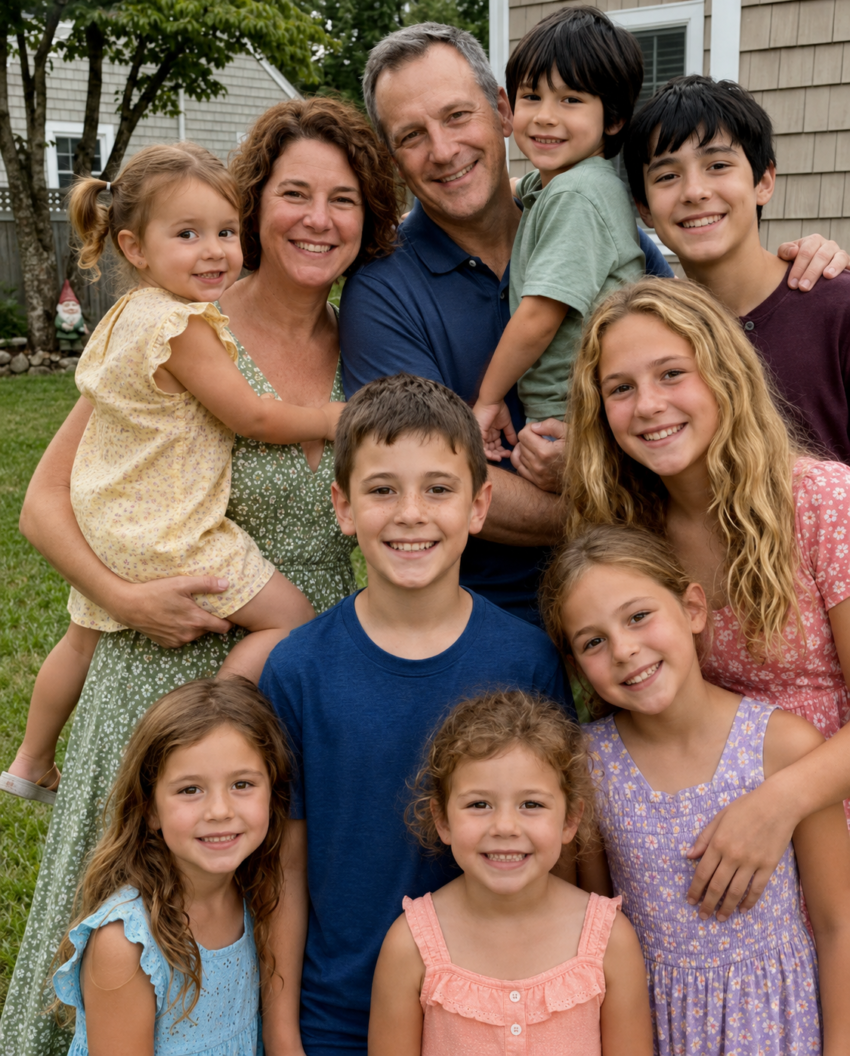
My husband, Hugh, and I had eight children—five daughters and three sons. There were always footsteps in the hallway, arguments over the bathroom, missing shoes, unfinished drinks, and someone shouting, “Mom!” from another room.
Sometimes I complained about the noise.
Now, I would give anything to hear it again.
Five years ago, Hugh took our three boys—Nate, Colin, and Sam—to our cabin in the mountains for their annual father-and-son weekend. They planned to fish, cook over a campfire, and spend two nights away from the chaos of home.
Hugh kissed me at the door before they left.
“Sunday afternoon,” he promised. “We’ll be back.”
They never came home.
A violent storm moved through the mountains that afternoon.
By evening, two police officers were standing at my front door.
I knew something terrible had happened before they said a word.
Their truck had gone off a steep section of road. It had overturned several times before coming to rest among the trees.
There were no survivors.
I remember asking the same question again and again.
“Are you sure?”
The officer said the road had become dangerously slick. Everything appeared consistent with a weather-related accident.
I couldn’t understand it.
Hugh knew those roads. He had driven them for years. He always checked the weather before taking the boys anywhere.
But grief doesn’t always allow you to think clearly.
You simply survive the next minute.
Then the next hour.
Then the next day.
A family friend named Darren was among the officers involved in the investigation. He had known Hugh for years, and seeing a familiar face during those terrible first days gave me a strange sense of comfort.
Darren told me the crash appeared straightforward.
“The storm changed everything,” he said. “The tires probably lost traction. Once the truck left the road, there wasn’t much anyone could have done.”
I wanted to believe him.
So I did.
The funeral passed like a dream.
Our five daughters slept beside me for weeks. Relatives filled the refrigerator with food. Neighbors brought casseroles. People whispered about how unfair life could be.
Eventually, everyone went home.
The house became quiet.
Too quiet.
I learned how to raise five girls without Hugh.
I learned to celebrate birthdays without three boys running through the kitchen.
I learned to look at an empty chair without expecting someone to sit in it.
But I never learned how to stop missing them.
Our youngest daughter, Maisie, had been only six when her father and brothers died.
She remembered little things.
The way Hugh whistled while fixing things.
The way he carried her when she fell asleep.
And the stuffed bear he had given her when she was small.
She called it Teddy.
For years, Teddy stayed on her bed.
Then, five years after the crash, everything changed.
It happened just after midnight.
Maisie woke me.
“Mom?”
I sat up.
She was standing in the doorway, holding Teddy against her chest.
Her face was pale.
“What happened?”
She walked toward me and handed me a folded piece of paper.
“I found this inside the bear.”
My hands immediately started shaking.
There was a small tear in the seam along Teddy’s back.
Inside was a piece of folded paper.
I opened it.
The handwriting was Hugh’s.
I knew it instantly.
The message contained only a few lines:
If something happens to me, don’t believe the first explanation. Something is wrong. Go to the cabin. Look beneath the living-room rug.
I read it again.
Then again.
Maisie stared at me.
“Mom,” she whispered, “Dad knew something was going to happen.”
I couldn’t answer.
For five years, I had believed my husband’s death was a terrible accident.
Now I was holding a message he had deliberately hidden before leaving.
And suddenly, the accident didn’t feel like an accident anymore.
The next morning, I drove to the cabin.
I hadn’t returned since the crash.
Every mile brought back memories.
Hugh laughing.
The boys arguing over fishing rods.
Their hands waving from the truck as they drove away.
When I finally reached the cabin, something immediately felt strange.
The place looked abandoned—but not completely.
There were signs that someone had been there.
A window appeared cleaner than the others.
The porch had less debris than I expected.
Inside, everything was mostly untouched.
Then I saw the rug.
My heart started pounding.
I pulled it aside.
One of the floorboards underneath was loose.
I lifted it.
Beneath it was a small hidden compartment.
Inside sat a plastic bag.
And inside the bag was an old recording device.
My hands were trembling so badly that I almost dropped it.
I pressed play.
Then I heard Hugh’s voice.
“If you’re hearing this,” he said, “then I didn’t get the chance to explain.”
I stopped breathing.
Hugh sounded frightened.
He said he had discovered something troubling involving an old police investigation.
Someone had altered information in an official report.
Evidence had disappeared.
Details had been removed.
And the person Hugh believed was responsible was someone he knew.
Then Hugh said a name.
Darren.
I felt the room spin.
The same Darren who had comforted me after the crash.
The same Darren who had explained the investigation.
The same Darren who had assured me there was nothing suspicious about Hugh’s death.
Hugh continued.
“I confronted him. I told him I couldn’t ignore what I’d found. I told him I was going to report it.”
There was a long pause.
Then his voice became quieter.
“I think telling him was a mistake.”
The recording ended.
I sat on the cabin floor, unable to move.
For five years, I had trusted Darren.
Now I wondered whether he had been standing beside me all those years because he cared—or because he needed to know what I remembered.
I drove home without telling anyone what I had found.
That night, I barely slept.
By morning, I had made a decision.
I called Darren.
I asked him to come over.
He arrived carrying two coffees.
Just like he had done countless times before.
“You sounded worried,” he said. “What’s going on?”
I told him to sit.
Then I placed the recorder on the table.
His eyes immediately went to it.
I pressed play.
The moment Hugh said Darren’s name, his expression changed.
The color disappeared from his face.
When the recording ended, he stared at the table.
“What is that?” he finally asked.
“You know exactly what it is.”
He tried to explain.
He said Hugh had misunderstood an old case.
He said the missing information hadn’t been important.
He said Hugh had been under pressure.
Then I asked the question that mattered.
“Did you change that report?”
Darren didn’t answer.
“Did you?”
Finally, he lowered his head.
“Yes.”
My heart sank.
He admitted that he had deliberately left information out of an earlier investigation.
But he insisted it hadn’t caused anyone’s death.
Then I asked him the question I had been afraid to ask for five years.
“What happened to Hugh?”
Darren looked at me.
“I don’t know.”
“Did you see him before he left?”
Silence.
“Darren?”
His jaw tightened.
Then he said something that made my blood run cold.
“I warned him to stay out of something he didn’t understand.”
I stared at him.
“You warned him?”
He didn’t respond.
Before I could ask anything else, someone knocked on the door.
Two investigators were standing outside.
Darren looked toward them.
For the first time, he seemed genuinely afraid.
One of the investigators told him they needed to speak with him about the reopened investigation.
Darren stood slowly.
As he walked toward the door, he turned back.
“I never meant for things to go this far,” he said.
I froze.
“What does that mean?”
He didn’t answer.
The officers took him outside.
And that was the moment I realized there was much more to Hugh’s death than I had ever known.
The investigation was reopened.
Old records were examined again.
The original crash evidence was reviewed.
Investigators discovered inconsistencies in reports that had been accepted years earlier.
They also uncovered evidence that Darren had been hiding information connected to the earlier case Hugh had discovered.
But there was still one question nobody could answer:
What happened during the final hour before Hugh’s truck went over the mountain road?
Months passed.
Then investigators found something.
A damaged piece of electronic equipment had been recovered near the original crash site but had never been properly examined.
It contained a partial recording.
Most of it was damaged beyond recovery.
But one section survived.
Hugh’s voice could be heard.
He was arguing with someone.
Then another voice appeared.
Darren.
The recording didn’t capture everything.
But it established something important.
Darren had been with Hugh shortly before the crash.
And Hugh had not been alone when he left the cabin.
Eventually, Darren was charged with multiple offenses related to the falsified investigation and obstruction of justice.
The evidence surrounding the crash itself remained complicated.
Some questions were never fully answered.
But one thing became clear:
The story I had been given five years earlier was incomplete.
The storm had been real.
The dangerous road had been real.
But there had been something else happening behind the scenes—something Hugh had discovered and desperately wanted me to know about.
He had understood that he might not make it home.
So he left clues.
One inside the cabin.
One inside his daughter’s stuffed bear.
He had trusted that, eventually, someone would find them.
Months later, I sat with Maisie on the back porch.
Teddy was beside her.
She asked me something I had heard many times.
“Do you think Dad knew we would find his message?”
I looked at her.
“I think he hoped we would.”
She held the bear against her chest.
For the first time in years, I didn’t feel only sadness when I thought about Hugh.
There was something else.
Relief.
He had not simply disappeared into a terrible story that ended on a mountain road.
He had tried to protect us.
He had tried to leave the truth behind.
And the smallest person in our family—the little girl who had once carried Teddy everywhere—had unknowingly become the person who finally uncovered it.
I still don’t have every answer.
I still don’t know exactly what happened in those final moments on the mountain.
But I know this:
For five years, I believed a storm had taken my husband and our three sons.
Now I understand that the storm was only part of the story.
The real story was hidden beneath a rug, inside an old recording, and in the torn seam of a little girl’s favorite stuffed bear.
And sometimes, the truth doesn’t disappear.
Sometimes, it simply waits for the right person to find it.