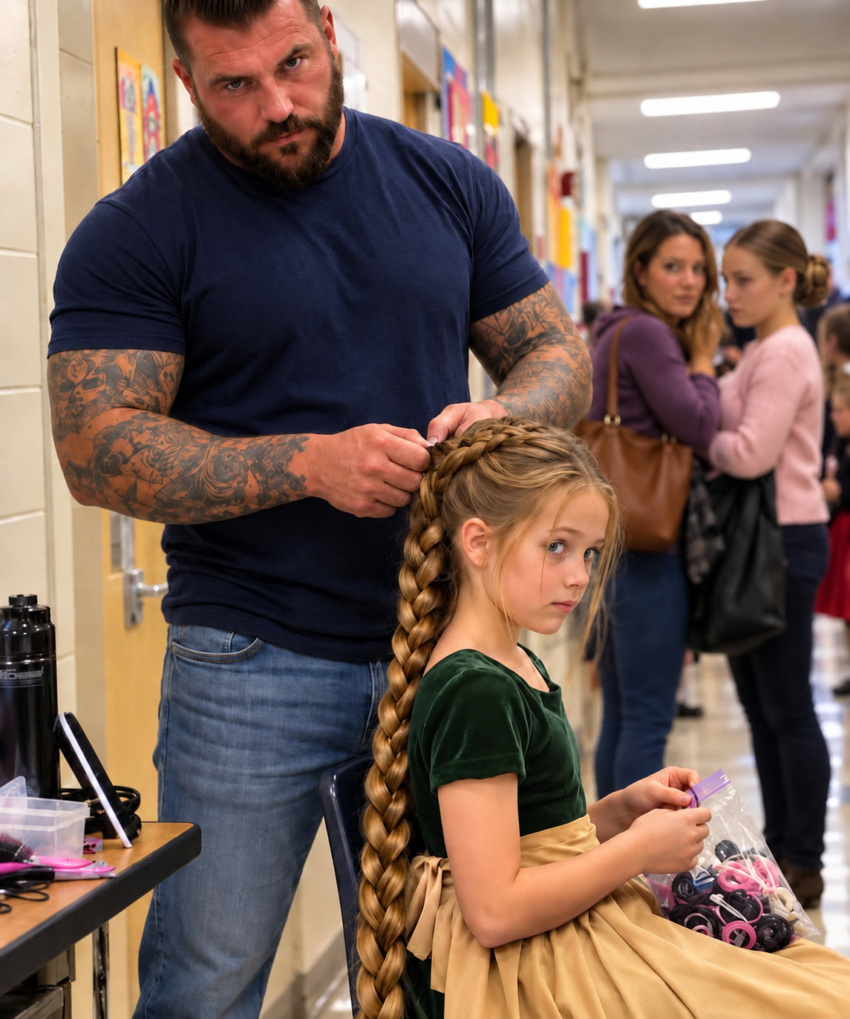
Everyone at school noticed Goldie’s incredibly long hair, but very few people realized how much effort it took for her to manage it every day.
Her thick braid reached well below her knees. It became tangled around chair legs, caught on backpacks, and sometimes forced her to hold it in her hands whenever she wanted to run or eat comfortably.
My daughter was in Goldie’s class, so I saw her often.
Goldie’s father was also a familiar face at school events. He would arrive straight from work carrying a folding mirror, brushes, ribbons, and a little container filled with hairpins.
Whenever his daughter needed her hair done, he would sit her down in the hallway and carefully take care of it himself.
Braids.
Ribbons.
Pins.
Every detail was handled with incredible patience.
By the time Goldie appeared on stage, her hair looked flawless.
The other parents often complimented him.
“What a wonderful father.”
“My husband can barely make a ponytail.”
“She’s lucky to have such a devoted dad.”
And they were right.
But whenever I watched him, I also watched Goldie.
I noticed how she lifted her braid whenever she ran.
How she gathered it onto her lap during lunch.
How she sometimes had to stop because the end of her hair had gotten caught beneath someone’s backpack.
She never made a fuss.
Still, she was only nine.
I often wondered why such a young girl had to organize so much of her life around the weight of her hair.
Nobody questioned it until the night of the winter concert.
Parents crowded the hallway outside the auditorium while the children prepared backstage.
As usual, Goldie’s father stood beside a window, working carefully through her hair.
Goldie sat quietly while he divided the strands, braided them, and secured everything with a silver ribbon.
Every now and then, she glanced toward her friends, who were laughing and running around nearby.
“Just a little longer, sweetheart,” her father said.
“I’m trying.”
“We’re almost finished.”
His voice was gentle.
When he finally finished, Goldie kissed his cheek and hurried toward her friends.
Her father remained behind, slowly gathering his brushes and pins.
Then one mother finally said what several people had apparently been thinking.
“She really should have had that hair cut years ago.”
Goldie’s father looked up.
“We’re managing just fine.”
Another parent shook her head.
“But look at her. That hair must be exhausting.”
Someone else added quietly,
“Maybe she should get to decide for herself.”
Goldie’s father stood there silently.
Then we noticed Goldie returning from the other end of the hallway.
She had heard them.
She walked straight toward her father.
“Please don’t talk about my dad like that.”
Everyone became silent.
“He takes care of me,” she said.
Her father gently touched her shoulder.
“It’s okay, sweetheart.”
“No, it isn’t.”
Then Goldie looked at the adults around her.
Her voice became quieter.
“My dad cries sometimes when he brushes my hair.”
Her father suddenly stopped moving.
Then Goldie revealed something none of us knew.
“I already asked him if I could cut it. He said we had to wait until I was seventeen.”
A parent asked softly,
“Why seventeen?”
Goldie looked at her father.
“Because of my mom.”
That was when everything changed.
Goldie explained that her mother had died of cancer when she was very young.
During her mother’s treatment, she had lost her hair.
Before she passed away, Goldie’s parents had made a promise.
Goldie would grow her hair until she was seventeen and then donate it to children who had lost their hair while battling cancer.
“It was for children like Mom,” Goldie said.
Her father gently corrected her.
“For children going through what your mom went through.”
Suddenly, his determination to preserve Goldie’s long hair made sense.
But there was still a problem.
Goldie was only nine.
Seventeen was still eight years away.
She pulled her enormous braid forward.
“I still want to donate it,” she said.
“I know,” her father replied.
“But I don’t want it this long anymore.”
Her father looked at her.
“It’s heavy,” she explained. “It gets caught on everything.”
“I know.”
“You always braid it and pin it up for me. But it’s still heavy.”
Her eyes filled with tears.
“I don’t want you to think cutting it means I don’t love Mom.”
Her father immediately knelt beside her.
“Never,” he said. “I would never think that.”
“Then why can’t I cut it?”
For the first time, her father had no answer.
The promise he had protected for years suddenly looked different.
His daughter wasn’t rejecting her mother’s memory.
She was simply asking whether honoring someone who had passed away meant she had to remain uncomfortable.
Two days later, my daughter came home with surprising news.
“Goldie is getting her hair cut on Saturday.”
Her father had changed his mind.
He eventually invited several parents to come to the salon.
When we arrived, Goldie was already sitting in the chair.
Her enormous hair had been divided into several thick braids.
The stylist showed her exactly where her new haircut would end.
Just above her shoulders.
Goldie looked nervously at her father.
“Is this okay?”
He smiled.
“Don’t ask me.”
She looked confused.
Then he said,
“It’s your hair.”
Goldie’s face immediately brightened.
Before the scissors came out, her father crouched beside her.
“There’s something I need you to understand,” he said.
Goldie reached for his hand.
“For years, I told myself this was about the promise your mother and I made. But it was more than that.”
His voice began to tremble.
“Taking care of your hair every morning… washing it, brushing it, braiding it before school… somehow made me feel closer to your mom.”
Goldie squeezed his hand.
“When your mother was sick, she worried about all the ordinary moments she might miss with you.”
He paused.
“School mornings. Birthdays. Family pictures. Watching you grow up.”
He wiped his eyes.
“After she was gone, doing your hair became one of the few things that made me feel connected to her.”
Then he admitted something he had never said aloud.
“Somewhere along the way, I stopped asking whether the promise was still fair to you.”
Goldie smiled gently.
“I like when you do my hair.”
“I know.”
“But I don’t like having this much hair.”
Her father laughed softly through his tears.
“That’s fair.”
Then he apologized.
“Your mother wanted us to do something kind. She never would have wanted that promise to become something that made life harder for you.”
Goldie still wanted to donate her hair.
She just didn’t want to wait eight more years.
This time, her father agreed.
The stylist lifted the first braid.
“Are you ready?”
Goldie took a deep breath.
“Ready.”
The scissors closed.
The first enormous braid dropped away.
Then another.
And another.
Little by little, years of heavy hair disappeared from her shoulders.
Finally, the last braid was cut.
Goldie touched her new shoulder-length hair.
Then she turned her head from side to side.
“Dad, look!”
Her father smiled.
“I’m looking.”
“It feels so light!”
Everyone smiled.
The braids were carefully collected and prepared for donation.
Before they were taken away, Goldie reached out and touched them one last time.
“Mom would be happy, right?”
Her father looked at the hair.
Then he looked at his daughter.
“Your mom would be happy with you.”
Goldie stared at him.
“With long hair, short hair, purple hair, or no hair at all,” he continued. “She would love you exactly the same.”
Goldie smiled.
“Even purple?”
Her father laughed.
“Okay, maybe not purple.”
For the first time that afternoon, everyone laughed together.
A few weeks later, I saw Goldie and her father at another school event.
He still had the same little mirror.
The same brushes.
The same box of pins.
And the same careful hands.
But there was no enormous braid anymore.
Instead, he styled two small sections near the front of her hair.
“You’re pulling too tight,” Goldie told him.
He immediately loosened them.
“Better?”
“Much better.”
He added a tiny ribbon.
Goldie stood up.
“Is it good?”
Her father smiled.
“Perfect.”
Then she ran down the hallway toward her friends.
Her hair didn’t catch on anything.
She didn’t have to carry it.
She didn’t need to stop and turn around.
Her father watched until she disappeared around the corner.
Then he quietly closed his little box of hairpins.
The promise Goldie’s parents had made wasn’t fulfilled exactly as they had originally imagined.
She didn’t wait until seventeen.
But she still donated her hair.
She still remembered her mother.
And she no longer had to carry something painful and inconvenient for eight more years simply to prove how much she loved her.
Sometimes honoring someone means holding tightly to the memories they left behind.
And sometimes, honoring them means realizing that it’s okay to let something go.