A few years ago, I started volunteering at a hospice near my home. I never imagined that one particular friendship would eventually change everything I thought I knew about my own life.
That’s where I met Eleanor, a seventy-year-old woman battling a serious illness.
Despite her condition, Eleanor had a wonderful personality. She enjoyed listening to music, talking about the past, and sharing stories about places she had always wanted to visit. During my visits, I would read books to her, bring her little treats, and spend hours listening to her memories.
Over time, we became very close.
One afternoon, during one of our conversations, Eleanor revealed something she had never experienced.
She had always dreamed of wearing a beautiful wedding dress, exchanging rings, and having someone stand beside her on a special day.
She had spent most of her adult life without the kind of companionship she had always hoped for. As the years passed, that dream became something she quietly carried in her heart.
“I know it might sound silly at my age,” she told me, smiling sadly. “But I’ve always wanted to know what it feels like to be a bride.”
I looked at her and realized how much that simple wish meant.
By then, Eleanor had become incredibly important to me. I wanted to give her something beautiful to remember.
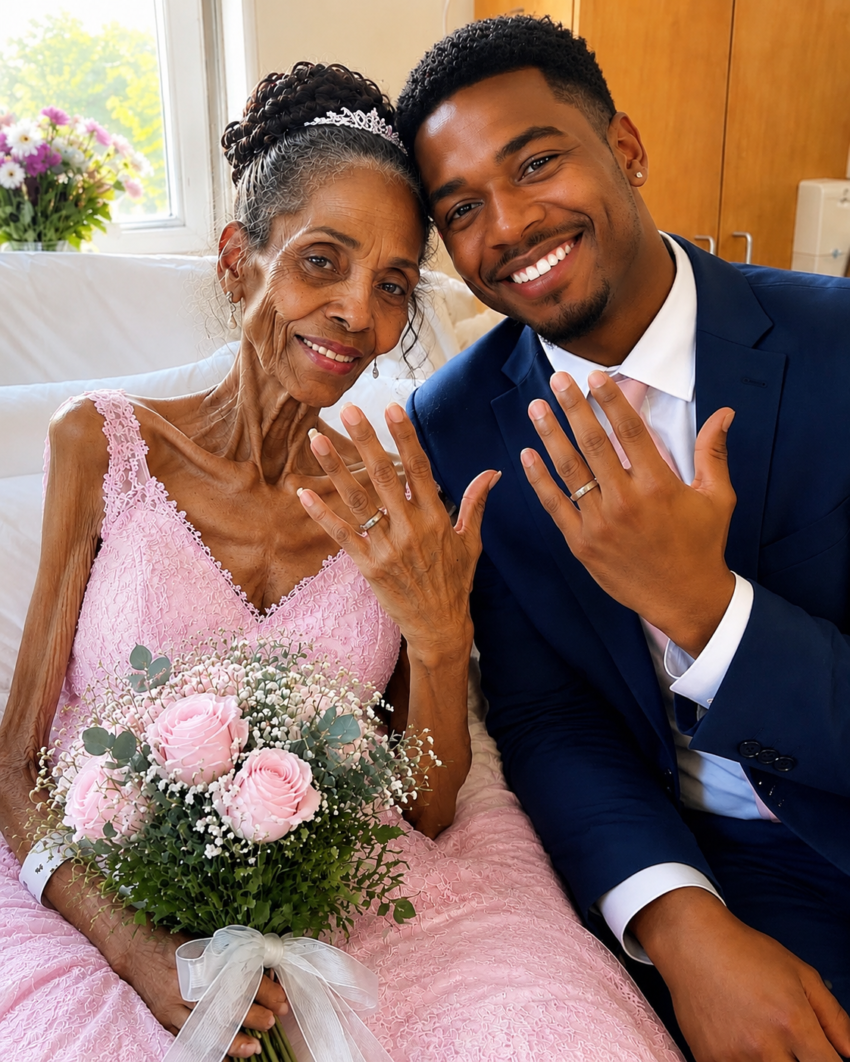
So I arranged a small wedding-style ceremony at the hospice. I found her an elegant white dress, arranged for a chaplain to attend, and organized a few decorations to make the room feel special.
On the day of the ceremony, Eleanor looked radiant.
She was feeling well enough to stand beside me for photographs. We exchanged rings, smiled for the cameras, and celebrated the moment with the hospice staff.
When she raised her hand to show her ring, her face lit up with happiness.
For that afternoon, we forgot about hospitals, treatments, and the difficult future ahead.
We simply celebrated her dream.
A few weeks later, Eleanor passed away peacefully.
Her funeral was a small gathering. Several hospice employees attended, along with a few people who had become close to her during her final months.
I stayed until the service ended.
As people began leaving, a gentleman wearing a dark suit approached me.
“Are you the person who spent so much time with Eleanor?”
I nodded.
He introduced himself as Mr. Hale, Eleanor’s longtime attorney.
“I’m very sorry for your loss,” he said.
Then he handed me a sealed envelope.
“Eleanor left specific instructions that I give this to you personally. There’s something you need to understand. She didn’t choose you by accident.”
I looked at him, confused.
“What does that mean?”
He gently replied, “I think you should read what she left behind before I explain everything.”
I opened the envelope.
Inside was a handwritten letter from Eleanor.
She thanked me for bringing happiness into her final years. She wrote that my visits had given her companionship, laughter, and moments she would always treasure.
But the final paragraph made my hands go cold.
It mentioned the hospital where I had been born, an adoption agency, and a date that matched the information my parents had always kept private.
I read those details repeatedly.
Then I looked at Mr. Hale.
“Why does Eleanor have information about my birth?”
He paused before answering.
“Because Eleanor had reason to believe that she was your biological mother.”
I couldn’t move.
For several seconds, I simply stared at him.
I had been adopted as a baby, but my parents had never given me many details about my birth family.
I had never imagined that the elderly woman I had been visiting at the hospice might have been connected to my own past.
I sat in my car for nearly an hour before deciding what to do.
Eventually, I called my mother.
After exchanging a few ordinary words, I asked the question I had been afraid to say aloud.
“Mom, was I adopted?”
There was a long silence.
Then she quietly replied, “I think it’s time we talked about that in person.”
When I arrived at my parents’ home, she was waiting at the kitchen table with two cups of tea.
She explained that she and my father had struggled for almost two years to have a child. Eventually, they contacted an adoption agency, and one day they received a call about a newborn baby.
They drove several hours to bring me home.
I was only three weeks old.
“We always planned to tell you,” my mother explained. “But we kept waiting until you were old enough to understand. Somehow, the right moment never seemed to come.”
I asked whether she had ever heard the name Eleanor.
My mother became visibly uncomfortable.
She remembered receiving a small amount of information about my biological mother. The name Eleanor had appeared in some of the original paperwork, but they had never been given further details.
I suddenly realized that the woman I had been visiting at the hospice might have spent decades wondering what had happened to me.
The following day, I contacted Ruth, a woman who had been close to Eleanor.
She lived in a quiet neighborhood about twenty minutes away.
When I arrived, she invited me inside and placed a large manila envelope on the kitchen table.
Before I opened it, she explained that Eleanor’s early life had been complicated.
When Eleanor was young, she had married a man named Gerald Marsh.
His family strongly disapproved of their relationship, and disagreements became worse after Eleanor discovered she was pregnant.
According to the records Eleanor had preserved, the circumstances surrounding the pregnancy and her marriage eventually led to the decision to arrange an adoption.
Shortly after giving birth, Eleanor signed the necessary documents.
But she never stopped wondering about her child.
Years later, she discovered that a family trust had been established for the child. It was intended to provide financial security once the intended beneficiary could be identified.
Eleanor spent years trying to establish whether the trust belonged to her daughter.
The envelope contained legal summaries, old correspondence, and documents explaining how the trust had been created.
It also contained information suggesting that my identity had been connected to the trust through an earlier investigation.
I felt overwhelmed.
Why hadn’t Eleanor told me everything while she was alive?
Ruth explained that Eleanor never wanted money to become the reason for our relationship.
She wanted to know whether I was happy. She wanted to understand the person I had grown into.
She had deliberately avoided pressuring me with information that could completely change my life.
The next morning, I returned to Mr. Hale’s office.
He explained that Gerald Marsh had later married again and had a son named Douglas.
Douglas had challenged the validity of the family trust. He believed the intended beneficiary had not been properly identified and questioned whether the original documents were sufficient.
He also wanted to protect his family’s financial interests.
Mr. Hale had been helping Eleanor gather evidence for years.
The records included hospital documents, adoption agency correspondence, financial papers, and statements from people who knew the history.
“Eleanor understood that there might be disagreements after her death,” he explained. “She wanted everything properly documented so the matter could be decided fairly.”
He advised me not to assume anything until the legal process was completed.
A few days later, I agreed to meet Douglas at a restaurant.
He was polite but clearly uncomfortable.
He explained that he believed the trust required further examination and that he intended to defend his family’s legal position.
I told him I understood his concerns.
However, I also believed Eleanor’s wishes deserved to be examined honestly.
We discussed the available documents, but neither of us changed our position.
Before leaving, Douglas told me that the matter would ultimately need to be resolved in court.
I drove home thinking about how complicated family history could become when important truths remained hidden for decades.
Whatever happened with the inheritance, I didn’t want the legal dispute to erase the memories I had shared with Eleanor.
Over the following weeks, Mr. Hale organized the evidence for a court hearing.
He showed me letters Eleanor had written to hospitals and adoption agencies over many years.
Some had received short replies. Others had never received answers.
There were photographs, appointment records, and handwritten notes documenting her attempts to locate her daughter.
One of the most emotional pieces of evidence was a recorded statement Eleanor had made several months before her death.
In the video, she sat beside the window in her favorite blue cardigan.
She explained the circumstances surrounding my adoption, the steps she had taken to investigate the family trust, and why she believed I was the child named in the original records.
She spoke calmly and carefully.
She never demanded that anyone accept her claims without evidence.
Instead, she asked that the documents be examined properly.
“I don’t want anyone to feel forced to believe me,” she said in the recording. “I only want the truth to be understood. And I hope the person I have been searching for knows that she was never forgotten.”
Hearing her voice again brought tears to my eyes.
A few days later, Ruth contacted me with another discovery.
Eleanor had rented a storage unit where she kept personal belongings, photographs, letters, and documents arranged by year.
I went there with Ruth.
Inside were several carefully labeled boxes.
As I opened them, I discovered decades of correspondence and handwritten notes.
One photograph caught my attention immediately.
It showed Eleanor standing outside a building where I had once worked.
I looked at Ruth in disbelief.
“Why would she have this?”
Ruth explained that Eleanor had once seen me there, years before we met at the hospice.
She had noticed a possible resemblance and wondered whether I might be her daughter.
But she didn’t want to approach me without stronger evidence.
Instead, she continued researching and eventually began volunteering at the same hospice.
A notebook contained an entry describing the day she had first recognized me.
She had written that she wanted to know the truth but was afraid of disturbing the life I had built.
I sat quietly, holding the notebook.
Suddenly, I understood that our friendship might have begun much earlier than I had realized.
The court hearing took place in a modest courtroom.
Douglas attended with his attorney, while Mr. Hale presented the documents Eleanor had collected.
The judge reviewed the family trust agreement, hospital records, adoption paperwork, financial documents, and Eleanor’s recorded statement.
Douglas’s attorney questioned whether the evidence was sufficient to establish my identity as the intended beneficiary.
Mr. Hale explained how the documents supported one another and why Eleanor had believed the trust was meant for me.
The judge carefully examined the dates and asked several questions about the trust’s creation and the steps taken to identify the beneficiary.
After reviewing everything, the court ruled that the trust was valid and that the available records sufficiently established my identity as its intended beneficiary.
Douglas’s challenge was dismissed, subject to the applicable procedures for further review.
I felt relieved, but I didn’t feel victorious.
The legal decision answered an important question, but it couldn’t bring Eleanor back.
It couldn’t restore the decades she had spent searching for me.
And it couldn’t give us another afternoon together.
Outside the courtroom, Mr. Hale congratulated me.
Douglas approached shortly afterward.
He acknowledged that the court had carefully considered the evidence, even though he had initially disagreed with the trust’s interpretation.
I told him I understood that the situation had been difficult for everyone.
We exchanged a few quiet words before going our separate ways.
As I walked toward the exit, I remembered the day Eleanor first told me about her dream of wearing a wedding dress.
At the time, I thought I was simply helping an elderly woman fulfill one final wish.
I had no idea that she was also connected to the most important unanswered question of my life.
Several days later, I returned to the hospice to collect some of Eleanor’s belongings.
Her room had already been prepared for another patient, but the chair beside the window was still there.
The hospice director handed me a small collection of personal items.
There were a few books, her blue cardigan, and the simple ring we had exchanged during our ceremony.
I sat quietly for a while.
The ring had a small clear stone. Eleanor had laughed when she first saw it because it was slightly too large for her finger.
She had joked that she liked having a little extra room.
I smiled as I remembered her happiness that afternoon.
The hospice director told me that Eleanor had often spoken about our friendship.
During her final weeks, she had said that my visits made her feel less alone and reminded her that life could still contain beautiful moments.
Those words meant more to me than I could explain.
I also thought about my adoptive mother.
She had raised me, loved me, and stood beside me throughout my entire life. Discovering Eleanor’s identity didn’t change the love I had for the woman who had welcomed me into her home when I was just three weeks old.
I had been fortunate enough to experience the love of two mothers whose lives had taken very different paths.
The inheritance would provide financial security and opportunities for the future.
But the most meaningful part of Eleanor’s legacy wasn’t the money.
It was discovering how deeply someone could care about another person, even after years of separation.
Before leaving, I thanked the hospice staff for everything they had done for Eleanor.
I carried her books and cardigan to my car and sat there for several minutes.
Then I called my mother.
I told her about the court decision, the photographs, the letters, and the notebook I had discovered.
We agreed that there were still many things to discuss, and we would take our time understanding everything.
As I drove home, sunlight reflected off the little ring resting beside me.
I thought about Eleanor’s smile on the day of our ceremony.
I thought about how a simple wish to wear a wedding dress had brought us together.
And I finally understood what Mr. Hale meant when he told me she hadn’t chosen me by accident.
Perhaps Eleanor had recognized something about me long before I knew the truth.
Perhaps she had simply wanted one last chance to know her daughter.
I couldn’t change the years we had lost.
I couldn’t give her the goodbye we both deserved.
But I could carry her kindness forward.
And whenever I look at that little wedding ring, I remember the seventy-year-old woman who taught me that some connections remain meaningful even when life keeps their stories hidden for decades.