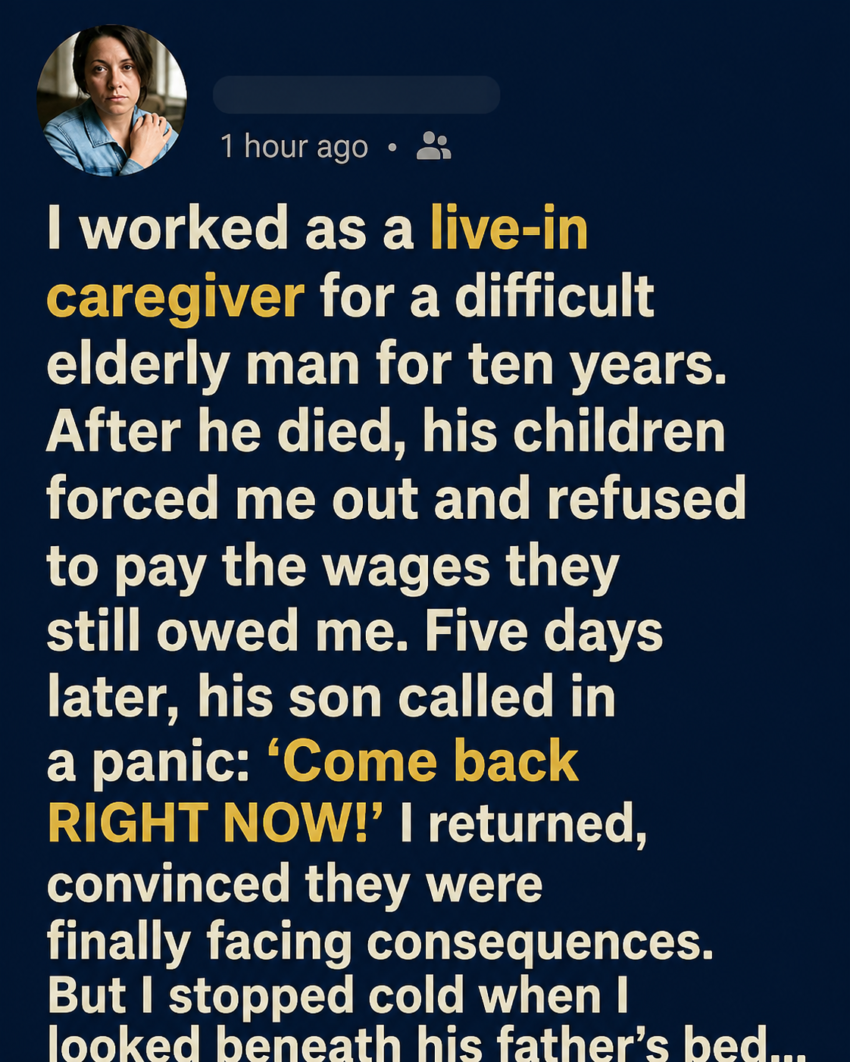
For ten years, I cared for a wealthy old man who rarely smiled, complained about almost everything, and treated most people as though they were a burden.
His name was Arthur Bennett.
When I first accepted the job as his live-in nurse, I was thirty-two years old and struggling to support my young daughter. Arthur had suffered a serious stroke, and his family needed someone who could stay with him around the clock.
The salary was good, the house was beautiful, and I desperately needed the opportunity.
I had no idea that the next decade of my life would be spent inside that enormous house.
Arthur was not an easy patient.
He complained about his breakfast, criticized the temperature of his tea, and sometimes accused me of moving things that he had misplaced himself.
If I opened the curtains, he wanted them closed. If I closed them, he complained that the room was too dark.
His children visited occasionally, but none of them seemed particularly interested in spending time with him.
His eldest son, Richard, was always busy discussing investments, property, and business matters. His daughter, Margaret, usually stayed long enough to ask whether their father had signed any important documents.
I gradually became the person who knew Arthur better than anyone else.
I remembered which medication made him sleepy, which foods upset his stomach, and how he liked his pillows arranged.
I sat beside him during sleepless nights, helped him bathe, prepared his meals, and listened to his stories when memories of his younger years made him emotional.
Sometimes he was particularly difficult.
Other times, he surprised me with unexpected kindness.
One winter evening, I found him staring at an old photograph of a woman.
“That’s my wife,” he said quietly.
I sat beside him.
“She looks beautiful.”
Arthur nodded.
“She was. She was the only person who ever understood me.”
His wife had died many years earlier, and I suspected that his loneliness had made him bitter.
Over time, he began trusting me with things he never discussed with his children.
He told me about his childhood, his business struggles, and the mistakes he had made as a father.
One afternoon, he said something that I never forgot.
“People think money tells you who someone is. It doesn’t. Wait until you become helpless. Then you’ll discover who actually cares.”
I didn’t know what to say.
I simply adjusted his blanket and continued reading his newspaper aloud.
During my ten years working there, Arthur occasionally mentioned something strange about his bedroom.
He had a large wooden bed with a thick frame and an old-fashioned headboard.
Every time I cleaned underneath it, he became unusually nervous.
“Leave that side alone,” he would tell me.
I assumed he simply disliked having his belongings disturbed.
One day, while helping him change the bedsheets, I noticed him watching me carefully.
“Promise me something,” he said.
“What is it, Mr. Bennett?”
“If anything happens to me, don’t let Richard throw away everything in this room before someone checks beneath the bed.”
I laughed gently.
“Why would I do that?”
His expression became serious.
“Because my son has spent years looking for something he doesn’t understand.”
I wanted to ask more, but he closed his eyes and refused to continue the conversation.
I never forgot those words.
Then, ten years after I began working for him, Arthur passed away.
He died peacefully one night while I was sitting beside his bed.
I had held his hand during his final moments.
It was heartbreaking.
Although he had been difficult, he had become an important part of my life. I cried when I realized I would never hear his familiar complaints again.
His children arrived the following morning.
Richard entered the house wearing an expensive suit and immediately began discussing arrangements with the funeral director.
Margaret walked through the rooms, checking furniture and personal belongings.
Nobody asked how I was feeling.
Nobody thanked me for caring for their father for ten years.
Three days after the funeral, Richard called me into the living room.
“We won’t be needing your services anymore,” he announced.
I looked at him in disbelief.
“Of course. I understand. But what about my final salary? There are still two months outstanding.”
He barely looked up from his phone.
“My father is gone. The employment arrangement ended with his death. You’ll need to discuss any financial matters with the estate.”
“But I worked those months. I also have unpaid wages from the previous month.”
He sighed impatiently.
“Please don’t make this difficult. We have enough things to deal with.”
Margaret entered carrying a folder.
“We need the room cleared by tomorrow morning,” she said.
I felt as though someone had punched me in the stomach.
Ten years.
Ten years of caring for their father, missing holidays, sleeping lightly in case he needed assistance, and putting my own life on hold.
And now they were throwing me out without even paying what they owed.
I packed my belongings quietly.
Before leaving, I stood outside Arthur’s bedroom for several minutes.
“Goodbye, Mr. Bennett,” I whispered.
Then I walked out of the house.
I returned to my small apartment with very little money and no idea what I would do next.
I was angry, hurt, and exhausted.
For the next five days, I tried calling Richard several times about my unpaid salary.
He never answered.
I eventually sent him a message explaining that I needed the money to cover rent and household expenses.
He ignored that too.
I began considering legal action, but I didn’t have the money to hire an attorney.
Then, on the fifth day, my phone rang.
It was Richard.
I answered immediately.
“Hello?”
His voice sounded completely different.
“Where are you?”
“At home. Why?”
“Listen carefully. You need to come back to the house immediately.”
I frowned.
“Why? You told me my services were no longer required.”
“Just get here! Right now!”
He sounded frightened.
I felt a strange sense of satisfaction.
Perhaps someone had finally confronted him about my unpaid wages.
Maybe karma had arrived.
I grabbed my coat, took a taxi, and returned to the Bennett estate.
When I entered, Richard was standing in the hallway. His face was pale, and Margaret was sitting on the staircase with tears in her eyes.
“What happened?” I asked.
Richard didn’t answer.
Instead, he pointed toward their father’s bedroom.
“Go inside. We need you to look at something.”
I entered the room.
Everything looked almost exactly as I had left it.
The furniture was still there, the curtains were closed, and Arthur’s old reading glasses rested on the bedside table.
Then I noticed something.
The wooden bed had been moved away from the wall.
A section of the carpet beneath it had been pulled back.
Richard looked at me nervously.
“We found something underneath the bed. We can’t figure out how to open it.”
My heart began beating faster.
I remembered Arthur’s warning.
Don’t let Richard throw away everything in this room before someone checks beneath the bed.
I knelt beside the wooden frame.
There was a small metal panel hidden underneath the bed, almost invisible unless someone knew exactly where to look.
I ran my fingers along its edge and discovered a tiny latch.
I pressed it.
A narrow compartment opened.
Inside was a black leather box.
Richard immediately reached for it.
“Give that to me.”
But I remembered Arthur’s words.
“Wait,” I said.
He stopped.
I carefully lifted the box and placed it on the bed.
It wasn’t locked.
Inside were several envelopes, a small notebook, an old photograph, and a sealed document bearing the signature of Arthur Bennett.
My hands began trembling.
The first envelope had my name written across it.
My name.
I slowly opened it.
The letter began:
“To the woman who stayed when everyone else found an excuse to leave.”
I covered my mouth.
Arthur had written it himself.
He explained that he had known about his children’s behavior for years. He knew they visited mainly when they needed money, wanted to discuss property, or hoped to influence his decisions.
He also knew that I had continued caring for him even when he had nothing to offer me.
The letter continued:
“For ten years, you gave me something my own family could not. You gave me dignity, patience, and companionship. I know I was not always easy to live with, and I know I rarely said thank you. But I noticed everything.”
Tears blurred my vision.
Then I reached the final paragraph.
“Everything you need to know is in the documents inside this box. I have made arrangements to ensure that the woman who cared for me will never be treated as disposable.”
I looked at Richard.
“What does this mean?”
He didn’t answer.
I opened the sealed document.
It was a copy of a legally prepared trust agreement.
Arthur had established a fund for my benefit several months before his death. The document stated that a substantial portion of his personal savings would be transferred to me in recognition of my decade of service and the companionship I had provided.
There was also a separate instruction regarding my unpaid wages.
The money was to be paid immediately from the estate.
But that wasn’t the only surprise.
At the bottom of the box was a second letter addressed to Richard and Margaret.
I unfolded it.
Arthur had written:
“My children, if you are reading this, then you have finally discovered the compartment I kept hidden. I hope you understand why I placed it somewhere you would only find after I was gone.
For years, I watched you treat the people around me according to what you believed they could give you. You rarely visited unless you needed something. You never asked whether I was lonely or frightened.
The woman you dismissed after my death spent ten years making sure I was comfortable. Yet you couldn’t even pay her what she had earned.
If you believe that my money belongs only to you because you carry my last name, then you have misunderstood everything I wanted to teach you.
Wealth is inherited. Character is earned.”
The room fell completely silent.
Margaret began crying.
Richard stared at the documents as though he couldn’t believe what he was reading.
Then he finally spoke.
“How much is in the trust?”
I looked at the attorney’s letter attached to the agreement.
The amount was far more than I had ever imagined receiving in my lifetime.
But something else caught my attention.
The final page contained a handwritten note from Arthur.
It said:
“Please don’t feel guilty about accepting this. You earned more than money could ever repay. Use it to give your daughter the opportunities I wish I had given my own children.”
I couldn’t hold back my tears anymore.
For ten years, I had cared for a man who rarely expressed affection.
I had never expected him to leave me anything.
I had only wanted to do my job properly and treat him with kindness.
And somehow, he had remembered every little thing.
Richard eventually lowered himself into a chair.
“I didn’t know Dad had done this,” he muttered.
I looked at him.
“You didn’t know because you weren’t here.”
He looked away.
Margaret approached me and quietly apologized for how they had treated me.
I appreciated her words, but I couldn’t pretend that everything was suddenly fine.
Their father’s death had not given them permission to erase ten years of my life.
Before leaving, I collected the documents and contacted Arthur’s attorney using the number provided in the letter.
The attorney confirmed that the trust had been properly established and that the estate was responsible for settling my outstanding wages.
Everything was handled through the proper legal process.
A few months later, I used part of the money to move into a comfortable home with my daughter.
I also returned to nursing, but this time I chose my working hours and refused to sacrifice every part of my personal life.
Sometimes I still think about Arthur.
I remember his complaints, his stubbornness, and the evenings when he asked me to sit beside him because he didn’t want to be alone.
I remember the way he used to say that people reveal themselves when someone becomes powerless.
He was right.
His children had a chance to show kindness when he was alive.
They missed it.
I had no idea that the man I cared for would leave behind a final act of gratitude that would change my daughter’s and my life.
And I learned something I will carry forever:
Never mistake someone’s quiet kindness for weakness. The people who give without expecting anything in return are often the ones who leave the deepest marks on our lives.
I spent ten years caring for a man who couldn’t always say thank you.
But in the end, he made sure I knew that none of those years had been forgotten.