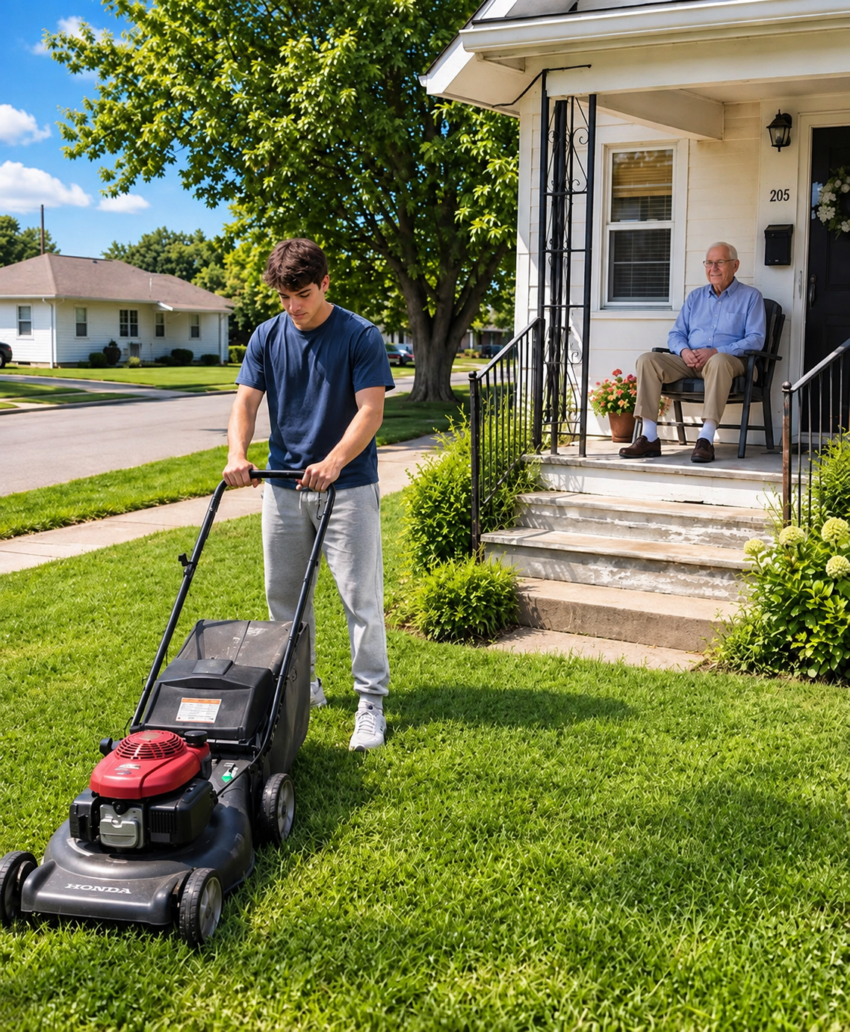
My teenage son had spent four years mowing our elderly neighbor’s lawn every Saturday without ever asking for payment.
Then, at the man’s funeral, an attorney walked straight toward my son with a sealed envelope.
“Mr. Vance left very specific instructions concerning you.”
I had absolutely no idea what was about to happen.
Raising Noah alone was never easy. His father disappeared before Noah was born, leaving me to handle motherhood and everything else on my own.
But Noah had always possessed a quality I admired deeply.
He noticed people.
Not the loudest people.
Not the most popular.
The people everyone else seemed to overlook.
That was how he came to know Mr. Vance.
The elderly man lived directly across the street from us. He had always been quiet, but after losing his wife, he became even more isolated.
He rarely visited with the neighbors.
He seldom spoke.
Most afternoons, he sat alone in an old chair on his front porch, quietly observing the world around him.
When Noah was fourteen, he noticed something that bothered him.
Mr. Vance was having trouble even walking down his driveway.
His grass had grown high and badly needed attention.
The following morning, Noah took our lawn mower, crossed the street and started cutting it.
He didn’t ask the old man for permission.
He didn’t mention payment.
He simply helped.
And what could have been a single act of kindness became a four-year tradition.
Every Saturday, Noah crossed the street and mowed Mr. Vance’s lawn.
He did it during blazing summer afternoons.
He did it on cold fall mornings.
Whenever he could, he showed up.
Mr. Vance wasn’t particularly talkative.
He would sit on his porch and watch Noah work.
When the job was finished, he’d occasionally give Noah a quiet nod.
Sometimes that was the only acknowledgment my son received.
But Noah never complained.
He wasn’t doing it for praise.
He just wanted to help.
Two weeks ago, Mr. Vance passed away.
When I told Noah about the funeral, he immediately said he wanted to attend.
“I should be there, Mom.”
The service was incredibly emotional.
Mr. Vance’s son and daughter sat together in the front row, visibly struggling with their father’s death.
Noah didn’t want to take attention away from them.
He wasn’t family.
He had simply come to say goodbye to an old man who had become part of his life.
So he chose a seat toward the back, close to the exit, and stayed quiet throughout the service.
When the ceremony ended, people began standing and slowly making their way outside.
Then I noticed a man in a dark suit entering the aisle.
At first, I assumed he was heading toward Mr. Vance’s children.
But he walked past them.
Then past several other guests.
And continued directly toward Noah.
He stopped in front of my son.
From inside his jacket, he pulled out a thick envelope.
It was sealed.
He held it toward Noah.
My son looked at him, completely confused.
The man introduced himself as the attorney responsible for Mr. Vance’s estate.
Then he said something I’ll never forget.
“Your neighbor left very specific instructions about this.”
Noah slowly reached out and accepted the envelope.
I looked at the attorney.
“What is it?”
He simply replied,
“It’s for Noah.”
Inside was a handwritten letter.
It was addressed personally to my son.
Mr. Vance explained that Noah’s weekly visits had become one of the few things he looked forward to after his wife’s death.
He had noticed everything.
He knew Noah wasn’t being forced to come.
He knew nobody was paying him.
He knew that every Saturday, the boy simply showed up because he had decided the old man deserved some help.
Mr. Vance wrote about watching Noah arrive, carefully mow the lawn, put everything away and leave without asking for recognition.
The grass itself, he explained, wasn’t what mattered.
What mattered was knowing someone remembered him.
Someone noticed when his yard needed attention.
Someone still cared enough to show up.
Then the attorney handed Noah another document.
Mr. Vance had established an education fund for him.
It was enough to cover Noah’s college tuition.
I was stunned.
My son was speechless.
But there was more.
Mr. Vance had also left Noah his old lawn mower.
It was the same mower Noah had used during those four years.
The one they had once repaired together after it broke down during the summer.
The letter made one thing very clear.
The money wasn’t payment for mowing the lawn.
Mr. Vance didn’t see it as a transaction.
It was his final way of thanking Noah for being there when he felt forgotten.
After the letter was read, Mr. Vance’s children came over to speak with Noah.
They told him something that completely changed how I viewed those four years.
Their father talked about Noah.
Often.
They said their busy lives and distance had made it difficult for them to visit as much as they wanted.
But their father had someone else to look forward to.
Every Saturday, he knew Noah would appear.
He would sit by the window or on the porch waiting for that familiar lawn mower to arrive.
That quiet nod Noah received at the end of each Saturday suddenly meant something much bigger.
It wasn’t indifference.
It was gratitude.
It was affection.
It was Mr. Vance’s way of saying, “I’m glad you’re here.”
Noah didn’t immediately accept the education fund.
He wanted to make sure it was truly what Mr. Vance had intended.
His children assured him that it was.
Eventually, Noah accepted it.
But the lawn mower meant just as much to him.
When we got home, he carefully cleaned it and placed it in our garage.
The handwritten letter went into a frame.
Noah hung it above his desk.
I asked him if receiving such a large gift would change the way he thought about helping people.
He shook his head.
“No, Mom. I would’ve done it anyway.”
And that answer told me everything.
Noah had never mowed that lawn because he expected something in return.
He did it because he saw an elderly man who needed help.
Four years of ordinary Saturdays had quietly become something extraordinary.
Mr. Vance had lost his wife.
He had become isolated.
He probably felt invisible to much of the world.
But every Saturday, a teenage boy crossed the street and reminded him that someone still noticed him.
And in the end, that simple kindness meant more than Noah could ever have known.
Sometimes we assume the smallest things we do don’t matter.
A lawn mowed.
A door held open.
A phone call.
A few minutes spent listening.
But when those small acts are repeated with genuine kindness, they can become incredibly important to someone.
Noah thought he had spent four years helping an old man with his yard.
He didn’t realize that, in return, Mr. Vance had given him something far more valuable:
a lesson about kindness, consistency, and the lasting impact of simply showing up for someone.