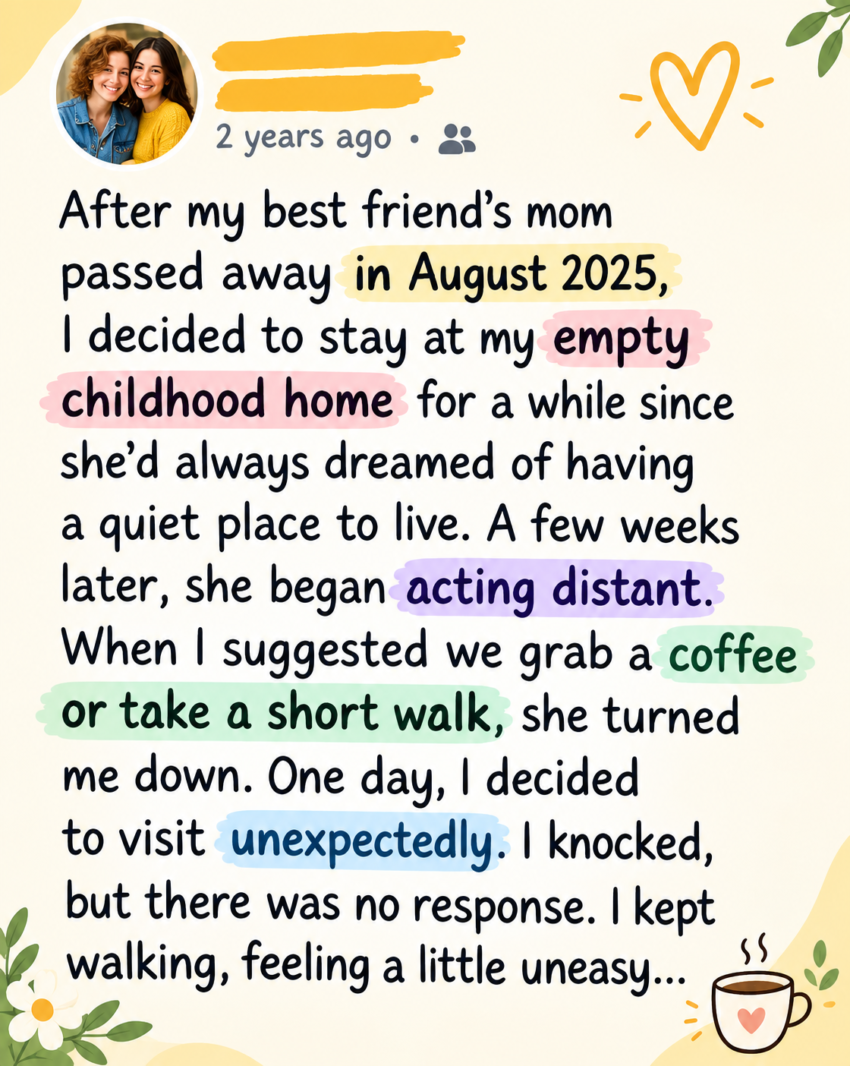
When my best friend’s mother passed away in August 2025, I knew there was nothing I could say that would make the pain disappear.
We had been friends since childhood. Our families had grown close over the years, and her mother had always treated me like another daughter.
After the funeral, my friend barely seemed like herself.
She was living in a small apartment that was constantly surrounded by traffic and noise. She couldn’t sleep, couldn’t concentrate, and spent most evenings sitting alone.
One day, I finally said,
“Why don’t you stay at my old childhood house for a while?”
The house had been empty for some time.
It was quiet, surrounded by trees, and filled with memories from my own childhood.
“You can stay there as long as you need,” I told her. “You don’t have to pay me anything.”
She looked at me with tears in her eyes.
“Are you sure?”
“Of course.”
A few days later, she moved in.
At first, everything seemed to improve.
She sent me pictures of the backyard.
She told me she was sleeping better.
One evening, she texted:
“I finally feel like I can breathe here.”
That message made me happy.
I thought I had given her exactly what she needed.
A safe place.
A quiet place.
A place where she could grieve without feeling watched.
But after several weeks, something began to change.
She Started Pulling Away
Her messages became shorter.
Instead of talking to me every day, she sometimes went two or three days without replying.
When I asked how she was doing, she always gave the same answer.
“I’m just tired.”
I tried not to take it personally.
She was grieving.
I reminded myself that grief could make people behave differently.
So I gave her space.
But eventually, the silence became difficult to ignore.
I would send her a message in the morning and receive nothing.
I’d check again that evening.
Still nothing.
Then another day would pass.
I started worrying.
Maybe she was getting worse.
Maybe something had happened.
Maybe she was alone in that big, quiet house with no one around.
I called her.
No answer.
I called again.
Nothing.
Finally, after nearly three days of silence, I couldn’t sit still anymore.
I bought some groceries, got into my car, and drove to the house.
I told myself I was only dropping off food.
But deep down, I knew I was going because I was scared.
Something Was Wrong
When I pulled into the driveway, the house looked completely normal.
The curtains were closed.
There were no cars outside.
I walked to the front door and knocked.
Nothing.
I knocked again.
Still no response.
“It’s me,” I called.
Silence.
I reached into my bag for my key.
Then I noticed something.
The lock looked different.
I tried my key.
It didn’t work.
My heart began racing.
I knocked harder.
“Are you in there?”
Nothing.
My mind immediately imagined the worst.
What if she’d hurt herself?
What if she’d fallen?
What if she had become so overwhelmed by grief that she had done something terrible?
I tried the handle.
To my surprise, the door opened.
I stepped inside.
And stopped.
The Scene I Never Expected
My best friend was sitting on the couch.
She was alive.
She looked tired, but she was safe.
And sitting beside her was my mother.
Both women had red eyes.
A tissue box sat between them.
Two mugs of tea were resting on the coffee table.
For several seconds, nobody spoke.
I stared at them in complete confusion.
“Mom?”
She looked at me.
“Come in.”
I slowly closed the door behind me.
“What is going on?”
My friend looked down at her hands.
“I’m sorry.”
“Why did you change the locks?”
She took a shaky breath.
“Because I needed to.”
That answer confused me even more.
“Why?”
My mother gently placed her hand over my friend’s.
“She asked me to come here.”
I looked at my mother.
“When?”
“A few days ago.”
I stared at my friend.
“Why didn’t you tell me?”
She began crying.
And then she finally explained.
The Truth Wasn’t What I Thought
She hadn’t been avoiding me because she was angry.
She hadn’t stopped answering because she no longer cared about our friendship.
She had been struggling with something she didn’t know how to explain.
“I didn’t want to keep calling you every time I broke down,” she whispered.
I sat across from her.
“You never have to apologize for that.”
“I know,” she said. “But you were doing everything for me. You gave me your house. You brought groceries. You called every day. You kept checking on me.”
She wiped her tears.
“And I started feeling like I was becoming your responsibility.”
My heart sank.
“You’re my best friend. You’re not a responsibility.”
“I know.”
She looked toward my mother.
“But I needed something you couldn’t give me.”
I understood immediately.
Her mother.
She needed someone who could sit beside her without asking her to explain her grief.
Someone who understood the strange emptiness of losing a parent.
Someone who could simply say,
“I know.”
My mother had become that person.
Why She Changed the Locks
I looked at my mother.
“You told her to change the locks?”
She nodded.
“Not because you aren’t welcome,” she said. “Because she needed the house to feel like her own safe space.”
My friend nodded.
“I was scared you’d think I was pushing you away.”
I felt tears forming in my eyes.
“You weren’t?”
She shook her head.
“No.”
She looked at me.
“I was trying to survive.”
That sentence stayed with me.
I had been measuring her grief through our friendship.
If she called me, I thought she was okay.
If she didn’t, I thought something was wrong between us.
I had never considered that maybe her silence had nothing to do with me.
She wasn’t leaving me.
She was trying to find a way to keep going.
I Finally Understood
I sat down beside her.
“You should have told me.”
“I was afraid.”
“Of what?”
“That you’d think I didn’t need you anymore.”
I reached for her hand.
“You’re wrong.”
She looked at me.
“I don’t need to be the only person helping you.”
Her eyes filled with tears again.
“I just wanted my friend back.”
“You still have me.”
We hugged.
My mother quietly smiled from across the room.
Then she said something I’ll never forget.
“Sometimes grief needs different kinds of love.”
We both looked at her.
“You gave her a home,” Mom continued. “I gave her a place to talk about her mother. Neither one of those things replaces the other.”
That was when everything finally made sense.
Love Doesn’t Always Mean Holding On
For weeks, I had been afraid that I was losing my best friend.
But I had misunderstood what was happening.
She hadn’t been replacing me.
She had been making room for another kind of support.
And I realized something important that day.
Helping someone doesn’t mean becoming everything they need.
Sometimes the greatest act of love is recognizing what you cannot provide and allowing someone else to fill that space.
I looked around the house.
The same house where I had grown up.
The same rooms where my own family had once gathered.
Now it had become a place where my best friend could heal.
And somehow, that made the house feel even more meaningful.
Before I left that evening, she walked me to the door.
“I’m sorry about the locks,” she said.
I smiled.
“Keep them changed.”
She laughed for the first time in weeks.
Then I hugged her.
“Just promise me one thing.”
“What?”
“Don’t disappear for three days without telling me you’re okay.”
She smiled through her tears.
“I promise.”
Months Later
My best friend stayed in the house for several more months.
My mother continued visiting her.
Sometimes they talked for hours.
Sometimes they simply sat together drinking tea.
And I stopped feeling threatened by their closeness.
Instead, I became grateful for it.
Slowly, my friend began healing.
She started going for walks again.
She returned to work.
She planted flowers in the backyard.
One afternoon, she sent me a picture of herself sitting beneath a tree with a cup of coffee.
The message said:
“I’m finally starting to feel like myself again.”
I smiled at the screen.
I realized then that I hadn’t lost my best friend.
Our friendship had simply changed.
It had grown.
I had once believed love meant always being the person someone turned to first.
Now I understood something different.
Real love doesn’t demand to be someone’s only source of comfort. It doesn’t compete with the people who help them heal.
Sometimes love means opening a door.
Sometimes it means stepping back.
And sometimes, it means accepting that there are things you cannot give someone—and being grateful when another person can.
I gave my best friend a house because I wanted to give her somewhere safe to grieve. I never expected that the greatest gift would be realizing she didn’t need me to save her. She only needed me to keep loving her while she found her way back to herself.